


Air quality in New Delhi deteriorated sharply yesterday as wind died down just as the burning of crop waste in fields sent smoke billowing across the north of the country.
A smoggy haze settled over the city, reducing visibility significantly, as the Air Quality Index (AQI) rose past 300 on a scale of 500, indicating “very poor” conditions that pose a risk of respiratory problems, according to the federal pollution control board’s guidance.
“Wind speed was supposed to pick up due to a deep depression in the Bay of Bengal, but that did not happen,” SAFAR, India’s main environment monitoring agency, said in its daily bulletin.
Lower wind speeds let deadly pollutants like PM2.5 particles hang in the air.
PM2.5, particles that are less than 2.5 microns in diameter, can be carried deep into the lungs, causing deadly diseases, including cancer and cardiac problems.
“The AQI is likely to be in the very poor to a poor category for the next two days,” SAFAR said, as the burning of crop waste, which accounts for about a quarter of air pollution in winter months, picked up.
Every winter, a thick blanket of smog settles over northern India as a combination of factors such as the burning of stubble in fields, industrial emissions and vehicle exhaust brings a spike in pollution.
Since October 1, Delhi’s average AQI was more than 36% higher than the figures for the same period a year ago, according to data.
Up until September, New Delhi and its satellite cities, which last year accounted for half of the dozen most-polluted cities worldwide, had enjoyed respite due to a strict lockdown to stem the spread of the novel coronavirus.
The Delhi government has appealed to the central government and neighbouring states to take proactive measures to tackle stubble burning.
Deputy Chief Minister Manish Sisodia said: “The smoke from stubble burning is spreading fast in Delhi. The Delhi government is making all efforts to reduce the air pollution in Delhi. The green area of Delhi has been increased and a new policy formulated for plying electric vehicles. Use of public transport is being encouraged and a smoke tower will be installed.”
According to the Delhi government effective measures have been taken to reduce pollution in Delhi which are gradually yielding the desired results.
The Delhi government wants other state governments to take concrete steps to eradicate pollution.
“The Delhi government is continuously taking strict action throughout the year to reduce pollution. However, pollution caused from stubble burning is not Delhi’s fault. It is not a major problem for Delhi only but the whole of north India suffers the consequences,” Sisodia said.
“During the ongoing corona pandemic, the pollution caused by stubble burning has posed a serious threat. The pollution not only affects the air quality in Delhi but is equally harmful for the families of farmers and labourers living in any village of Punjab where the stubble is burnt. I request the central and the state government to pay necessary attention to air pollution.”
Also yesterday, the Delhi government has asked the Delhi Pollution Control Committee (DPCC) to levy a Rs2mn fine on North Municipal Corporation of Delhi for flouting dust control norms at the city’s Bhalswa dumping sites.
Delhi Environment Minister Gopal Rai yesterday announced the decision while conducting an inspection of the sites in an effort to oversee that norms are followed under the anti-dust campaign in Delhi.
Finding “large-scale violation” of Delhi government guidelines, the minister said all departments should remain vigilant in dealing with the growing pollution in the national capital.
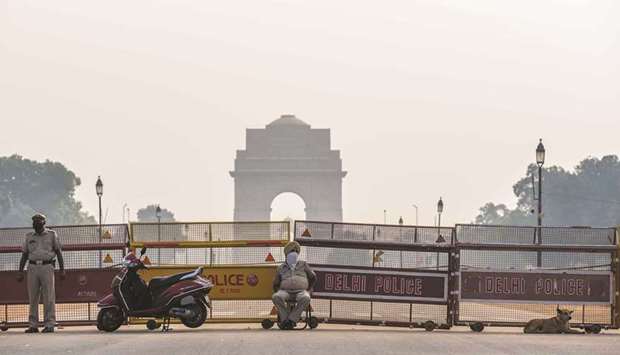
Police guard a road near India Gate amid smoggy condition in New Delhi yesterday.