


Virginia Commonwealth University School of the Arts in Qatar (VCUarts Qatar), a Qatar Foundation partner university, is making use of 3D technology to print analogue cameras due to Covid-19 limitations.
The Covid-19 respiratory disease is caused by the coronavirus.
When classes started for the 2020 fall semester, faculty and staff at the university’s Painting and Printmaking (PAPR) department realised that they would not be able to import enough analogue cameras for all the students in time for the start of the course.
Analogue (or pinhole, as it is popularly referred to) camera photography being an integral part of the PAPR curriculum – and purchasing cameras from within the country proving to be too expensive – faculty and staff started making their own cameras.
“We realised that due to the Covid-19-induced delays to business processes and shipment, we didn’t have the luxury of time to import enough analogue cameras for our students,” says Khalifa al-Obaidli, adjunct instructor at VCUarts Qatar’s PAPR department. “And purchasing them locally was too expensive an option.
“As creatives and designers, we’re trained to look for solutions. In this specific case, that meant making our own.
“Online research revealed an open source link to designs that could be 3D printed.
“We discussed our idea with the FabLab team, who were excited about the possibility of creating analogue cameras from scratch.”
Al-Obaidli and other PAPR faculty, including Aissa Deebi, Abir Zakzok and Rola Khayyat, worked with VCUarts Qatar’s FabLab team to 3D print various component models first; Saga Elkabash from the FabLab team further adapted these models to meet the specific requirements of the PAPR curriculum that includes analogue or pinhole photography.
“The beauty of analogue photography – unlike digital photography – lies in being able to observe the actual process of photo development, from shooting an image, to dark room development,” al-Obaidli explains. “It’s a chemical process that results in an image materialising before your very eyes.
“As an instructor, I’ve seen the reaction of students as they watch the black and white outlines emerge on paper – any doubt they may have had, is replaced by wonder and joy.
“This is why teaching analogue photography is important in art and design.
“It gives practitioners a thorough understanding of the basics and history of image production.”
The FabLab team 3D printed seven components for each camera – camera body, camera body cap, winding knob, winding stud, take-up knob, take-up stud and aperture clip – with each camera taking up to seven hours to print.
The timely collaboration between the two departments meant that all 20 students on the pathway have enough analogue cameras to continue their course undisrupted – with a few extra ones to spare.
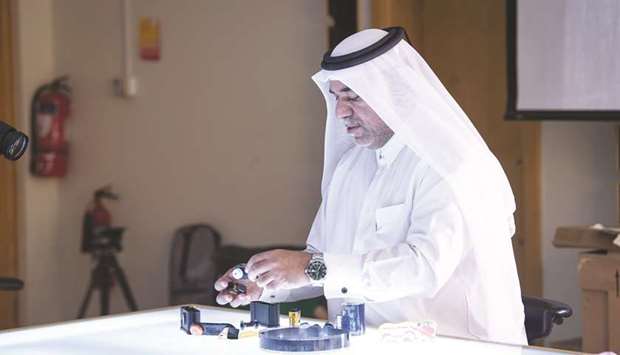
Al-Obaidli examines a 3D printed analogue camera.