


India’s coronavirus caseload topped 7mn yesterday when the Health Ministry reported 74,383 new infections in the previous 24 hours, with a rise in infections in southern states offsetting a drop in western regions.
Deaths from Covid-19 rose by 918 in the last 24 hours to 108,334, the ministry said.
India added a million cases in just 13 days, and the country has the second-highest number of infections, behind the United States which is approaching the 8mn mark.
Kerala, which won praise for its early handling of the coronavirus pandemic, on Saturday reported 11,755 new cases, the highest in the country.
Neighbouring Karnataka and its capital Bengaluru, where many software companies are based, has also been struggling to contain the spread of the virus.
Prime Minister Narendra Modi’s government, faced with a collapsing economy after imposing a tough lockdown to try to stem the spread of the virus in late March, is pushing ahead with a full opening of the country just before the festival season.
But India’s festival season, which climaxes in October and November with the popular celebrations of Dussehra and Diwali, poses additional challenges, as officials try to dampen the usual large public celebrations and cross-country travel.
Typically the festival season brings a big increase in consumer spending, and the more sombre atmosphere this year will further dampen an economy that contracted by almost a quarter in the three months to June - the worst figure on record.
A few states such as Maharashtra and Gujarat have put restrictions on gathering during the nine-day Navratri festival due to begin on October 17.
“Festival season is approaching. A little carelessness of people during festivals can worsen the situation,” federal Health Minister Harsh Vardhan told his social media followers in a broadcast yesterday.
“There is no need to congregate in large numbers to prove your faith or your religion. If we do this we may be heading for a big trouble,” Vardhan said.
The minister defended the ayurveda-based interventions in the treatment of Covid-19 and hailed its efficacy in boosting immunity.
“Ayurveda has a holistic approach towards disease management wherein salutogenesis is a major approach towards treatment of a disease condition and its prevention,” he stated.
Ayurveda interventions are prescribed after in-depth study of literature, scientific studies, experimental studies, and clinical studies, Vardhan added.
The minister had recently come under sharp criticism from the Indian Medical Association against the release of Ayush-based National Clinical Management Protocol.
The IMA had criticised the minister for promoting “placebos” instead of evidence-based medicines.
Vardhan also said that a rollout of the indigenously-developed faster and cheaper “FELUDA” Covid-19 test is expected in the next few weeks.
“While I cannot put an exact date on the availability, we should expect this test within the next few weeks,” he said.
The FNCAS9 Editor-Limited Uniform Detection Assay (FELUDA) test is a paper strip test, similar to a pregnancy test, and has been approved by the Drug Controller General of India for commercial launch.
The test was developed by Tata CRISPR (Clustered Regularly Interspaced Short Palindromic Repeats) and the Council of Scientific and Industrial Research’s (CSIR) Institute of Genomics and Integrative Biology (IGIB).
Developed by Dr Souvik Maiti and Dr Debojyoti Chakraborty at the CSIR-IGIB, FELUDA has been touted to provide results in 45 minutes and is priced at Rs500.
Vardhan said the test has already been validated by the Department of Atomic Energy’s Bengaluru-based National Centre for Biological Sciences.
FELUDA is an alternative to the quantitative RT-PCR tests and experts found it highly specific.
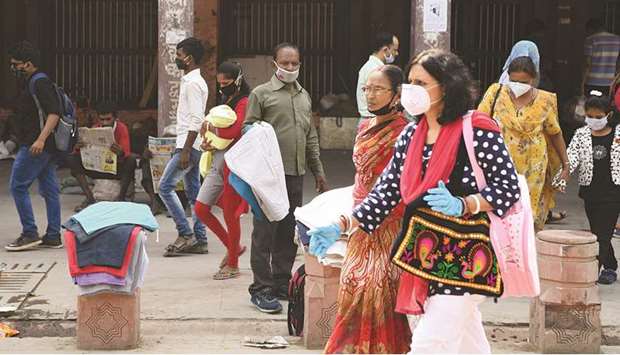
Shoppers wearing masks walk through a market in the old quarters of New Delhi yesterday.