


Europe surpassed 100,000 daily reported Covid-19 cases for the first time on Thursday, after countries such as Russia and United Kingdom saw no respite in the mounting number of infections every day in the past five days.
The Covid-19 respiratory disease is caused by the coronavirus.
Cases throughout Europe have been steadily rising over the past week even as new infections in worst-affected countries such as India and Brazil have shown signs of slowing down.
The epicentre of the outbreak in the European region has moved to the United Kingdom, Russia, Spain and France, which have reported at least over 10,000 cases each in the last three days.
Russia reported yesterday its highest daily coronavirus cases ever since the last record in May, prompting Moscow authorities to mull closing nightspots.
The United Kingdom recorded more than 17,000 cases on Thursday, with the country’s Health Minister Matt Hancock warning that the United Kingdom was at a “perilous moment”.
Europe currently has recorded over 16% of total global coronavirus cases and nearly 22% of deaths worldwide due to the virus.
On Thursday, when daily reported cases breached the 100,000 mark, Eastern Europe was the worst affected region with over 33,600 daily reported cases.
Among the 10 countries in the region, including Ukraine, Russia and the Czech Republic, eight posted record increases in cases in the past week.
In Northern Europe, Britain was the sole country with a mammoth caseload.
New infections in the country have risen more than 2.5 times since the beginning of October showing no signs of slowing down.
Italy, in the southern region of Europe, recorded over 4,000 cases for the first time since April when the country was slammed by virus.
The daily number of cases in the country has been consistently rising for three months.
The country has the second-highest death toll in the continent, with 36,083 dying since the outbreak erupted in February.
Spain’s government invoked a state of emergency yesterday to impose a partial lockdown on Madrid.
With 850 Covid-19 infections per 100,000 people, the Madrid area has Europe’s highest infection rate.
In Western Europe, France recorded new daily Covid-19 infections above the record 18,000 threshold for two days in a row on Thursday, with hospitals moving to an emergency mode and its biggest cities closing down establishments to curtail further spread of the virus.
Belgium too enforced stricter controls on gatherings after new infections surged in the country.
New coronavirus cases rose more than 2.6 times since the beginning of October.
Covid-19 has already claimed more than 10,000 lives in the country, which has a population of 11mn people.
In Europe, daily cases averaged around 78,000 cases for since the beginning of October, compared with an average of 47,500 cases in September.
People in Madrid and the surrounding towns reacted with anger yesterday after the Socialist-led government invoked a state of emergency to reimpose with immediate effect a partial lockdown to curb the spread of the new coronavirus.
Some of the 3.8mn people affected in the capital and eight satellite towns said the politicians had bickered while contagion rates soared.
“They are clowns, they are making fun of us as much as they can and more. They (politicians) have no shame,” said Pilar Lopez, a cleaner.
Shop assistant Linda, who did not give her second name, thought the blanket state of emergency imposed on the capital was going too far.
“I think certain areas should be restricted, but not the entire Madrid region,” she said.
Felix, 49, a Madrid resident, blamed irresponsible behaviour by residents for high infection rates.
“It’s also got to do with the lack of precaution from citizens. If we had behaved better, we would not be at this point,” he said.
Yesterday Italy was grappling with fears of a second coronavirus wave similar to the ones seen in Britain, France and Spain, as it registered over 5,000 new infections in 24 hours.
“We’re under extreme pressure,” the World Health Organisation (WHO)’s Italian government adviser Walter Ricciardi said, warning that spaces in Covid-19 hospitals were running out in the worst-hit regions.
Italy registered 5,372 new cases yesterday, the health ministry said, nearly 1,000 more than on Thursday.
The country has not seen such high numbers of recorded new infections since mid-April.
New infections are still well behind Britain, France and Spain, which are registering between 12,000 and 19,000 cases in 24 hours.
But Ricciardi said the rise in cases could reach those levels in Italy just as winter begins and common influenza strikes.
“When the flu comes, we risk having 16,000 cases in a day,” he said in an interview with broadcaster Sky TG24.
“I am very worried ... (about) sub-intensive units because there are infectious patients who need to be treated in a certain way and beds are already running out. And that’s before the flu hits,” he said.
Meanwhile, Poland reported a record daily rise in coronavirus cases for the fourth consecutive day yesterday, with 4,739 reported new infections, the health ministry said, as the country readies for a renewal of some restrictions from today.
Wearing masks outside will be compulsory across the country, and a tightening of measures in schools is also expected to be announced.
On Thursday, Prime Minister Mateusz Morawiecki did not rule out introducing a state of emergency if the number of cases continues to grow.
Some groups who also oppose vaccinations have said they will organise protests around the country today against the order to wear masks.
In total, the country of 38mn has reported 116,338 infections and 2,919 deaths.
Russia registered its highest-ever number of new coronavirus infections yesterday after officials warned that tight restrictions could be set back in place if people continued to flout anti-virus rules.
Restaurants and nightspots in Moscow were bustling and many residents were ignoring orders to wear masks in public as nationwide infections surged in September, but officials stopped short of imposing new sweeping measures.
Officials in Russia, which has the world’s fourth-highest caseload behind the United States, India and Brazil, have so far dismissed the idea there is a second wave of infections or any need for a new lockdown.
An official government tally registered 12,126 new cases yesterday, surpassing the country’s previous record set in May by several hundred cases.
German Chancellor Angela Merkel has warned that coronavirus hotspots in Germany will be given 10 days to tackle their rising case numbers before tougher action is taken.
“We all sense that the big cities, the urban areas, are now the arena where we will see if we can keep the pandemic under control in Germany as we have done for months, or if we lose control,” Merkel said after talks with mayors. “The coming days and weeks will decide how Germany gets through the pandemic this winter.”
Capital Berlin and financial hub Frankfurt both joined a growing list of high-risk zones on Germany’s map this week, after crossing the threshold of 50 new cases per 100,000 people over the past seven days.
Among the new measures that kick in once that level is reached are wider mask requirements, including outdoors in busy areas, as well as earlier closing hours for bars and restaurants and limits on alcohol sales and group sizes, Merkel and the mayors agreed.
Merkel said past experience had shown it takes “about 10 days” to see if such efforts succeed in slowing the outbreak.
If the infection rate does not stabilise in that time, “further targeted restrictions are unavoidable in order to further reduce public contacts”, according to the text agreed at the talks.
Germany, long seen as having managed the pandemic better than most European countries, is on heightened alert after the number of new daily cases spiked from 2,828 on Wednesday to just over 4,000 cases on Thursday – the highest daily figure since early April.
The country’s Robert Koch Institute (RKI) for disease control warned that the virus could “spread uncontrollably” if people let their guard down.
Yesterday the RKI reported 4,516 new cases.
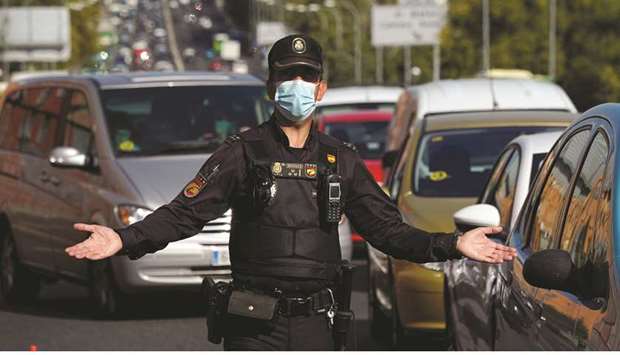
A Spanish National Police officer gestures at a traffic checkpoint during a partial lockdown in Madrid.