


Many states in the international community give their diplomatic services the greatest education and expertise in order to produce highly qualified professionals, with diverse specialities on different issues leading to a fundamental objective: having good relations between countries and new actors in the international relations arena.
In this way, states are able to train professionals with high qualifications and with the ability to design strategies that allow them to communicate with appropriate knowledge in the broad theme of diplomatic relations.
Additionally, often solving passing difficult situations in the regional and international sphere.
Good neighbourliness, security, co-operation and the principles of justice within our societies force us to accept a commitment that has one main ultimate purpose: the well-being of people.
Even though the international contradictions continue to have political and economic issues, we must continue putting efforts in resolving the current global epidemiological virus affecting our planet.
This international scenario represents greater tenacity for professional and human diplomacy to play an important and pragmatic role. At the same time, working on diversifying forms that maintain the sustainable development of nations in peaceful co-existence, protection and assistance in the face of states who are in need.
Thanks to digital diplomacy, the development of new relationships, productive discussions, and efficient virtual meetings of representatives and higher authorities, this has eased the process of seeking greater impetus bilateral relations.
Thus, establishing strategic partnerships and action plans, as witnessed within the various platforms in Qatar.
The proactive, dynamic and pragmatic role of states has been strengthened due to obtained human resources achieved based on efforts, developments, and a greater serenity.
Moreover, leading our government officials and representatives into making the right decisions according to current circumstances.
On the other hand, regional and international security is described as the pillars of foreign policies.
These fundamental strategies hold a constant presence in an effort to achieve better governance within all nations, forming strength within the international community.
As far as trade and exchange of goods and services is concerned, both the bilateral and multilateral co-ordination are equally relevant during these unexpected times; with the participation of all in the framework of meetings of concertation, co-operation and measures of mutual trust.
May I highlight the Peruvian-Qatari relationship and emphasise this good diplomacy that welcomes us here in Qatar.
We have continued to consolidate our relationships in various thematic axes.
For example, we welcome our agricultural products in the markets in Doha and we’re continuing to collaborate within all difference aspects, which will be discussed in the very near future in the Second Consultation Mechanism to be held in December close to the highest level among our ministries.
Recently, in Peru, the Binational Cabinets have been implemented, which include meetings of representatives with their ministers of state, who come from various neighbouring countries.
These so-called Binational Cabinets are carried out between two countries with the participation of Heads of State and the heads of sectors, where both sides maintain common interests.
They constitute a mechanism for co-ordination and decision-making at the highest level and allow work on a common agenda for joint development and mutual support to achieve objectives for the benefit of their societies.
In addition, our bilateral relationship has always been strengthened under an equitable and supportive relationship, strengthening concrete co-operation in agreements in various fields, in which both countries can exchange our developments.
We also agree on a foreign policy for the pursuit of equal opportunities; Ambassador Javier Pérez de Cuellar, former Secretary of the United Nations once said “In reality, development is a kind of infinite career or process in relation to the scope of science and technology” I think with this new science and technology, we all agree that it should be used for good.
On the other hand, we have seen a forward-looking vision that involves glimpsing ideal processes for the benefit of foreign policy.
In addition, trying to perceive obstacles that must be identified, a prospective focused on the role of ending an unfavourable situation so that a political-diplomatic nation is prepared and that a problem that can be resolved under principles governing good relations of international co-existence, as well as a prospective that allows to look into certain difficulties that may arise in certain regional bodies.
I mentioned as an example, the Alliance of the Pacific, composed of Peru, Mexico, Colombia and Chile (June 6, 2012), whose objective is to form an area of integration for the growth, development and competitiveness of the economies that make it up.
The maintenance of an external dynamic activity has been strengthened in search for a positive image for the countries we maintain.
Like the title of this article, stability, security and progress, through a greater link of the promotion of what we have been doing with the limitations imposed on us by this contradictory time.
I wish to end this message by paraphrasing an Arabic proverb that says, “In order to strengthening the heart, there is no better exercise than crouching down to lift those who are fallen” We have seen this in this great country, Qatar.
— Peru’s ambassador to Qatar Jose Benzaquen Perea
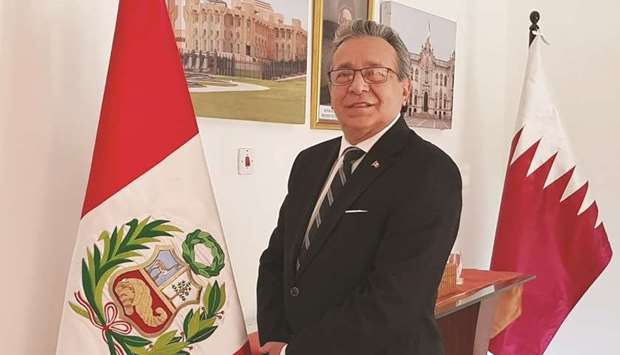
Peru’s ambassador to Qatar Jose Benzaquen Perea.