


Police set up controls and stopped cars on major roads into and out of Madrid yesterday as the city went back into lockdown due to surging coronavirus cases.
Some 4.8mn people are barred from leaving the capital area, while restaurants and nightspots must shut early and reduce capacity by half.
The new restrictions, which started on Friday evening, are not as strict as the previous lockdown in March, when people were barred from leaving home.
However, authorities advised residents not to move around unless absolutely necessary.
Travel is banned except for work, school, health or shopping.
“There are fewer people then we’re used to, shops are empty, (nightspots) are empty, there’s a feeling of sadness,” said Valerio Rojo, director of the Circulo de Bellas Artes cultural organisation.
“We had reservations but many people have called to cancel them,” said Macarena Molina, who works in a hostel in central Madrid. “Today, we had a reservation through Booking and they cancelled just an hour before saying they were not going to travel because of the restrictions.”
The latest measures ordered by the Socialist-led central government were reluctantly imposed by the conservative-led Madrid government, which has warned that they would cripple the economy.
Madrid’s nightspots and restaurants must close at 11pm instead of 1am, while restaurants, gyms and shops must cut capacity by half.
Gatherings of more than six people remain banned.
Near the Plaza Mayor square, usually packed with tourists on a Saturday lunchtime, waiter Luis stood, menu in hand, trying to drum up business.
“No one is walking past here,” he said. “I don’t know how much longer we are going to keep our jobs.”
However, inside the city, little appeared to have changed with life largely carrying on as normal on a brilliant October morning with a sharp autumnal chill in the area.
“Everything’s open and you can’t see police anywhere. We can move around Madrid but you can’t go out to the nearby villages or to the mountains,” says Feliza Sanchez, 78. “I don’t know how this is going to change the situation we have at the moment.”
“Nothing has changed, it’s just like any other day in the neighbourhood,” shrugged Martinio Sanchez on a busy street in Madrid.
“They should have done this in August and maybe we wouldn’t be where we are right now,” said this 70-year-old as he walked his dog through the eastern neighbourhood of Ciudad Lineal.
Jorge Alvarez said the restrictions wouldn’t have much impact on his life.
“In principle, nothing will change. I will continue to live a normal life because you can’t lock yourself up inside your house and not work,” said Alvarez, a 49-year-old metal worker.
“Who knows if it will stop the virus spreading? But obviously people in food and drink industry are going to lose a lot of money,” he said.
With 850 cases per 100,000 people, according to the World Health Organisation (WHO), the Madrid area has Europe’s worst rate.
Spain had 789,932 coronavirus cases as of Friday, up by 11,325 since Thursday, and there have been 32,086 fatalities.
Daily deaths are around their highest levels since early May although far below the late March record of nearly 900.
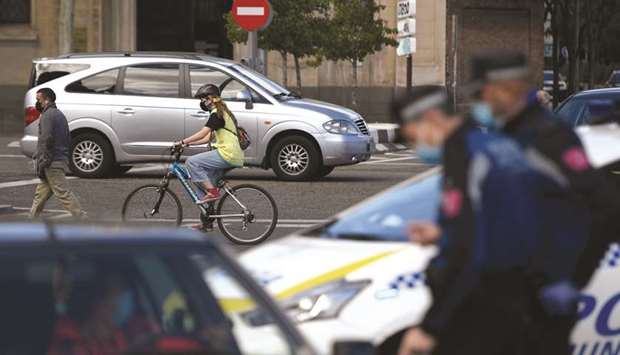
People wearing face masks cross a street as local police officers control people’s movement at a traffic checkpoint in Madrid.