


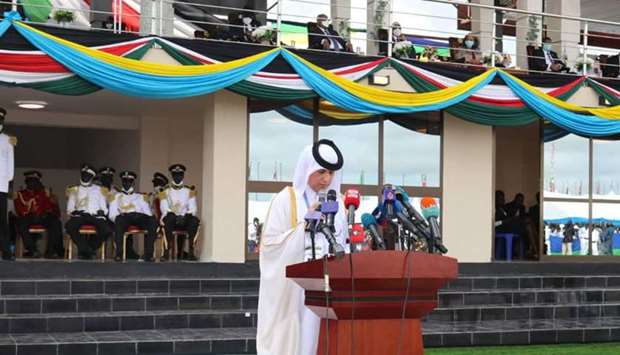
Qatar participated on Saturday in the final signing ceremony of the peace agreement between the transitional government of the Republic of Sudan and the Sudanese armed movements, which was held in Juba, the capital of South Sudan.
The delegation of Qatar at the ceremony was headed by HE the Minister of State for Foreign Affairs Sultan bin Saad al-Muraikhi.
The minister conveyed to the mediating state and the signatories of the peace agreement the greetings of His Highness the Amir Sheikh Tamim bin Hamad al-Thani, and the wishes of the government and people of Qatar for success.
HE al-Muraikhi said in Qatar's speech that it is a pleasure to address during the unique moment in history, when everyone has devoted themselves to peace, and rejected war, and responded to the voice of reason and conscience, adding that this moment relates to the hopes of many who have been displaced by war and made refugees, and for return to the embrace of the nation that awaits peace, development, reconstruction and prosperity.
The minister expressed Qatar's appreciation to the Republic of South Sudan, and the President, Lieutenant General Salva Kiir Mayardit, for sponsoring the negotiations, the negotiation delegations and the mediation committee for their patience and wisdom, which brought about the historic moment.
He stressed that Qatar was not far from peace issues in Sudan, as it sponsored a similar experience represented in the Darfur Peace Agreement, which brought together all stakeholders in May 2011, between the government of Sudan and the armed movements, after a long and arduous period of negotiation with all parties related to the conflict in Darfur.
The minister said the agreement addressed the roots of the conflict and its repercussions, and that the journey to implement the Doha Agreement extended for years and was the most difficult, as it went through challenges and obstacles of every kind and everywhere, but said Qatar has always been ready to overcome obstacles and challenges, and followed the strategy of looking ahead and continuing the path, instead of waiting or wasting time by stopping and turning back.
He pointed out that there are several models for the successful strategy, represented in the donors conference organised by Qatar in April 2013. Qatar worked on a package of development programmes, the most important of which is building service complexes or what is known as model villages in 15 locations in the five states of Darfur, to facilitate voluntary return of displaced persons.
Al-Muraikhi said that he has referred to these details because the next stage is the stage of building peace and implementing the protocols agreed, which needs a similar effort to make peace, and which needs to be done in the same spirit of brotherhood because Sudan will benefit from it, along with its people and neighbours.
He appealed to the movements that have not yet attended, and have not participated in the peace process, to join the peace process to achieve security, stability, development and prosperity for Sudan and its people, and called on everyone to work together.
In conclusion, the minister thanked everyone who helped in this historic moment in the history of Sudan.