


With coronavirus infections soaring, the city of Madrid braced yesterday for a partial lockdown that will cut it off from the rest of the country.
The coronavirus causes the Covid-19 respiratory disease.
The new restrictions, which will also apply to nine other nearby towns where infection rates are high, came into force at 10pm (2000 GMT) with people only allowed to leave the area for work, school or medical and legal reasons.
Although Madrid’s regional leaders have agreed to implement the restrictions, they strongly oppose the closure, filing an appeal at the National Court to challenge its legality.
The new measures, which will initially be imposed for 14 days, will affect 4.5mn people in the city and the other nine towns, requiring them to avoid all unnecessary travel, but not confining them to their homes.
The provisions were outlined in a decree that lays down conditions for restrictions in areas where the virus is spreading rapidly, which were agreed on Wednesday at talks between the health ministry and most of Spain’s 17 regions, which are responsible for managing the pandemic.
In reality, Madrid is the only region where the restrictions will apply, given its infection rate of 730 cases per 100,000 people, compared with just 300 per 100,000 in the rest of Spain – which in itself is the highest in the European Union.
The talks came after a two-week standoff between the left-wing coalition government of Prime Minister Pedro Sanchez and Madrid’s right-wing administration headed by Isabel Diaz Ayuso over the region’s management of the crisis.
But the new rules will be difficult to apply within the capital, which is home to 3.2mn people, with regional officials warning the mobility restrictions will cause mayhem.
“Thanks for the chaos, Pedro Sanchez,” tweeted Diaz Ayuso.
And Madrid’s justice chief Enrique Lopez warned the closure would cost the economy €8.0bn ($9.4bn) over the course of a month.
But Sanchez, speaking in Brussels, said that Madrid was facing “a moment of extraordinary gravity” and defended the move as necessary “to limit the circulation of the virus” in a region that counted 36% of Spain’s infections in the past fortnight.
For now, the court challenge will not impede implementation of the restrictions.
In the first few days, police will not be issuing fines until the new restrictions are validated by a regional court.
With so many exceptions to the rule, monitoring the mobility restrictions is likely to be something of a logistical nightmare in a city where 2mn trips are made every day.
As they currently stand, the new rules suggest a person living outside the city could take a suburban train, travel 15km to the office, then go shopping or have a drink with friends after work anywhere within the capital.
“There are so many loopholes that checking everyone to find out why they are travelling is going to be very difficult,” warned Madrid’s mayor Jose Luis Martinez Almeida.
The rules will also mean that 1mn people living in badly-hit areas in or around the capital who have been under a localised lockdown – some for four days, others for 11 – will now be able to circulate freely.
The partial lockdown is far less stringent than the one imposed across the country in March and April, which was one of the toughest in the world.
Back then, people could only leave home to buy food, to work or for medical reasons and for a long period were not allowed out for a walk or to exercise.
The virus has now killed nearly 32,000 people in Spain and has infected around 760,000.
Meanwhile, the French health ministry has reported 12,148 new confirmed coronavirus infections over the past 24 hours, lower than Thursday’s 13,970 and well below highs of over 16,000 seen last week.
The total number of infections since the start of the epidemic rose to 589,653.
France also reported 136 new deaths from coronavirus – the highest daily toll since mid-May – for a cumulative total of 32,155.
Last Friday it had reported a death toll of 150 in one day.
Hospital admissions for Covid-19 rose by 106 to 6,758 and intensive care admissions by 11 to 1,276, continuing an uptrend from recent weeks.
Poland’s daily coronavirus cases topped 2,000 for the first time yesterday, the latest record in a surge in infections that has raised the possibility that the government will have to bring forward the introduction of new restrictions.
Having weathered the first wave of the pandemic better than most western European neighbours, Poland has seen daily infection rates spike, with more than 1,000 new cases each day over the last week.
The country of 38mn reported 2,292 daily coronavirus cases and 27 deaths related to Covid-19 yesterday, the health ministry’s Twitter account said.
In total, Poland has reported 95,773 cases of the coronavirus and 2,570 deaths.
Local authorities have ruled that face masks will have to be worn at all times out of doors in the Italian capital Rome and the surrounding Lazio region.
Italy on Thursday registered more than 2,000 new coronavirus cases for the first time since the end of April.
Lazio accounted for some 265 of those cases and has been increasingly concerned by the growing contagion.
A number of other Italian regions, including Campania centred on Naples, have already made mask wearing obligatory outdoors.
Previously, masks had to be worn only in closed public spaces, such as shops and cinemas.
“Most of the cases are tied to the lack of respect in using masks and in social distancing,” Lazio’s health chief Alessio D’Amato told reporters yesterday as he announced the new measure.
Italy was the first country in Europe to be slammed by Covid-19 and has the second highest death toll in Europe after Britain, with almost 36,000 people dying since the outbreak flared in February.
It has 317,409 cases.
Thanks to one of the strictest lockdowns in the world, the government managed to get the contagion under control by the summer.
Cases have slowly picked up over the past two months but Italy is still seeing far fewer daily infections than elsewhere in Europe, with France, Spain and Britain all registering thousands more cases per day.
Prime Minister Giuseppe Conte has ruled out any return to a nationwide lockdown, but officials have said tighter restrictions might have to be applied in future to limited areas to contain any localised flare-ups.
Denmark will cull around 1mn mink after finding further coronavirus infections among the animals at farms that breed them for their fur, authorities said.
The Nordic country is the world’s largest producer of mink and had previously culled animals on farms hit by infections, but outbreaks have persisted.
Fresh cases have been registered at 41 mink farms and another 20 were believed affected, totalling up to 1mn minks, Environment and Food Minister Mogens Jensen said at a press briefing on Thursday evening.
As a precaution, the culling will include farms situated within 8km of a farm with infected mink.
“My main focus is on ensuring, that the ... mink farms do not become an infection risk for people, and therefore the government has decided to cull the mink,” Jensen said.
In May, Spain ordered the culling of all 93,000 mink at a farm to prevent human contagion after finding that most of the mink there were infected with the coronavirus.
The Netherlands reported a similar outbreak and undertook a cull after two people were reported to have been infected by mink, though such cases of animal-to-human transmission are believed to be extremely rare.
There have also been occasional cases of zoo animals and house pets coming down with the coronavirus during the global pandemic, with their owners the likely cause of infection.
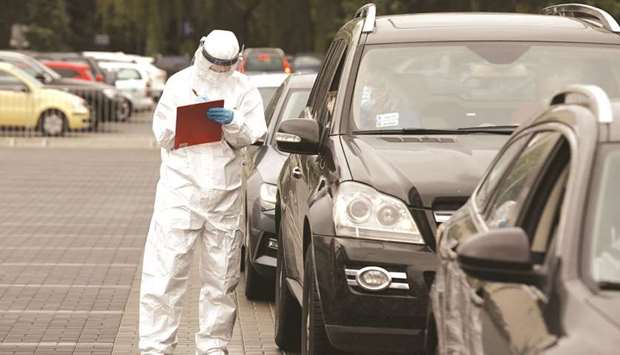
A healthcare worker takes details at a drive-through testing centre in Warsaw.