


Guardian News and Media/London
Prime Minister David Cameron has outlined plans to boost the “right to buy” public housing, a scheme introduced under Margaret Thatcher’s government in the 1980s, as part of plans to “fire up” the economy.

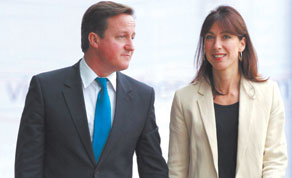
Prime Minister David Cameron and his wife Samantha arrive back at their hotel on the first day of the Conservative Party’s annual conference in Manchester yesterday
The prime minister made the announcement to increase discounts to encourage tenants to buy their ‘council’ homes as the Conservatives began the first day of their annual party conference amid Tory (Conservative) rumblings about the government’s growth strategy.
“We need to do everything we can to fire up the engine of the British economy,” said Cameron in an interview on the BBC’s Andrew Marr Show.
“There’s a step-change taking place right now,” he added.
He also insisted the government was right to do “difficult things” to cut the deficit, before conceding that ministers need to do a better job of explaining to those affected why the spending cuts are necessary.
He stressed that the government “isn’t just sitting back” in terms of boosting growth as he laid out a package of measures on housing which he said could together provide 200,000 extra homes, create 400,000 extra jobs and give young people the chance to buy their own homes.
The original right-to-buy scheme introduced by the Conservatives in the 1980s was criticised for cutting the social housing stock available to those on low incomes.
Under Labour, the discounts were reduced thereby discouraging take-up of the scheme.
But Cameron said the money from council house sales would be invested into building affordable homes for those on low incomes, which would also boost jobs in the construction industry.
The prime minister also highlighted plans to hand thousands of acres of land to developers to build homes.
Construction companies will be allowed to take over sites that have been developed but have fallen into disuse, and will only pay for the land when the properties they have built are sold.
House-building fell to its lowest peacetime rate since 1924 under the last Labour government, Cameron said.
“The housing market isn’t working. Why isn’t it working? Because of the debt crisis, the banks are bunged up with debt, so the banks aren’t lending, the builders aren’t building and the buyers can’t buy because they can’t get the mortgages that they need.
“So this government isn’t just sitting back, we are rolling up our sleeves and saying right, we’re going to make over government land to house-builders on the basis that they can build now and pay for the land when they sell the homes.
“That could build 100,000 homes, 200,000 jobs in our economy. We’re not stopping there, we’re saying let’s bring back the right to buy your council house, with proper discounts that Labour got rid of, and let’s use that money, as people choose to buy their council home, let’s use that money to build homes for rent, for low rents for families that are currently stuck on housing lists.”
He said there were more than 2mn council homes still available for purchase.
“This is something that could make a big difference and again that could provide another 100,000 homes, another 200,000 jobs. So taking those two policies together that could provide 200,000 extra homes, 400,000 extra jobs.”
But there are concerns about the availability of affordable homes amid moves to scrap strict planning rules compelling house-builders to include such properties in private development schemes.
The National Housing Federation, which represents housing associations, has warned this could prove a significant setback for affordable house-building.
The economy is expected to dominate the Conservatives’ four-day annual party event.
Fellow Tory Andrew Tyrie, who chairs the influential House of Commons Treasury select committee, used the runup to the gathering in Manchester to warn that the government’s economic response was “incoherent and inconsistent”.
Cameron defended the government’s policies, saying he was not prepared to put at risk the plan for getting the country’s debt and deficit “under control”.
Eurozone ‘could blight world economy’
Prime Minister David Cameron yesterday said the eurozone had to get on with fixing its financial problems or risk pulling down the entire world economy. Speaking in Manchester, Cameron said eurozone leaders must “roll up their sleeves” as they only had weeks to get it right. “Frankly, right now the eurozone is a threat not just to itself and the British economy, but a threat to the worldwide economy and so we have to deal with this,” he said. Cameron added now was not the time for a British referendum on whether to stay in or leave the 27-member European Union - a subject which may be debated in the next session of parliament. “Clearly there is a real problem in the eurozone and we’ve got to deal with that problem,” Cameron said. “The government has a very clear view, a view that we are pushing with partners in Europe, with the International Monetary Fund, with others about what needs to be done,” he said. “Strengthening the financial mechanisms in Europe, greater involvement for the IMF, facing up to the debts and the problems and dealing with them decisively: This is what needs to happen.” Cameron, who is staunchly against joining the euro currency, said it would be “very bad” for Britain if the eurozone broke up, given that 40% of British exports went to those 17 countries.