


European shares ended lower in a wild trading session yesterday as technology stocks tracked losses on Wall Street, while merger talks between two major Spanish lenders lifted the banking index.
The pan-European STOXX 600 index settled 1.1% lower after flitting between gains and losses, while also shedding about 1.9% for the week on a two-day technology rout.
Wall Street indexes plummeted on losses in the technology sector, which retreated sharply from record highs after leading the rebound from pandemic-driven lows.
The European technology sector fell 2.7% to end at a one-month low, underperforming its peers for the week with a 4.1% drop.
German software developer Nemetschek bottomed out the STOXX 600, shedding 9.4%.
On the other hand, Bankia and Caixabank marked double-digit gains after both Spanish banks said they were considering a merger to create the biggest lender in the country.
Caixabank was among the top percentage gainers in the banking index and the STOXX 600.
Basic resource stocks were also among the few gainers for the day, tracking a rise in base metal prices and an expected uptrend in Chinese demand.
The STOXX 600 has stayed well within a trading range seen since June, as a eurozone economic recovery appeared to be running out of steam.
A batch of middling economic data this week bolstered expectations that the ECB would maintain an accommodative stance to support inflation, in line with the US Federal Reserve.
“The Fed’s decision to move to an average inflation target has set the scene...given the still high level of uncertainty surrounding any economic outlook, the ECB is highly unlikely to change its policy stance at next week’s meeting,” Carsten Brzeski, chief economist, eurozone and global head of macro at ING wrote in a note.
With European interest rates in negative territory, the ECB has undertaken massive bond-buying programs this year to boost liquidity through the coronavirus crisis.
Real estate stocks sank 3.5%, led by Germany’s Vonovia after it announced a 1bn euro ($1.18bn) capital raise.
Curevac rose 3.4% after the German biotech firm won nearly $300mn in government funding to speed up work on its prototype Covid-19 vaccine and build capacity to produce it at scale.
Late Thursday, Spanish savings conglomerate Bankia said in a statement that it had made contact with CaixaBank “with a view to a potential merger”, but that no agreement had yet been reached.
The deal would create a Spanish banking titan, with more than 650bn euros ($770bn) of assets, in a sector battered by the effect of the coronavirus on the wider economy.
The news sent Bankia stocks rocketing 26.7 % to 1.31 euros and CaixaBank surging 14.5% to 2.08 euros yesterdayy.
The combined group would be Spain’s third largest lender after Santander and BBVA — whose share prices also chalked up solid gains.
Elsewhere, Asian markets fell deep into negative territory following painful losses Thursday on Wall Street, where the tech sector finally succumbed to profit-taking after months of mind-boggling gains.
The drop had been expected after the Nasdaq climbed around 80% from its March trough, with analysts warning that valuations were out of sync with economic realities.
Meanwhile, closely-tracked US jobs numbers showed that the economy is continuing to recover from the coronavirus pandemic, as it added 1.4mn jobs in August, broadly in line with analysts’ forecasts.
US employment is nonetheless still well below where it was in February, and some economists warned that without census hiring, the August report was actually weaker than it appeared.
The government has hired nearly 600,000 workers in the past two months.
In London, the FTSE 100 closed up 0.6% to 5,884.66 points; Frankfurt — DAX 30 ended down 0.5% to 12,992.67 points; Paris — CAC 40 closed up 0.3% to 5,026.50 points; Madrid — IBEX 35 ended up 1.0% to 7,074.70 points and EURO STOXX 50 closed down 0.1% to 3,301.94 points yesterday.
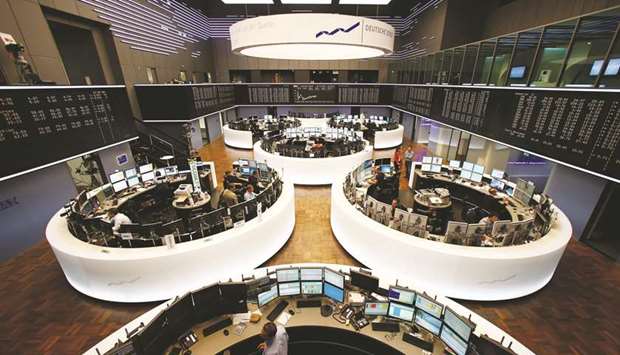
Traders monitor data on computer screens at the Frankfurt Stock Exchange. The DAX 30 closed down 0.5% to 12,992.67 points yesterday.