


A shower of economic reports during an emerging-market rally would, under normal circumstances, be used to help gauge whether the gains are justified.
But since normal circumstances disappeared with Covid-19 many months ago, the growth and manufacturing reports from China, India, Brazil and South Africa that are due this week are potentially less decisive for traders than the simple fact that central banks still have the markets’ back.
That dynamic was rarely more in evidence than last week, when Federal Reserve Chairman Jerome Powell signalled policymakers will remain accommodative for longer through more tolerance of inflation, a stance that drove US stocks to fresh records and the dollar lower as real yields declined. All of which provided renewed support for emerging markets.
“That’s going to bode well both for emerging-market currencies – and credit as well,” said Ali Malik, an investment adviser at Bank of Singapore. “We’re dollar bears.”
A gauge of developing-nation domestic bonds was on the cusp of its longest sequence of monthly gains since June 2014 as of Friday. The benchmark equity index, having erased its losses for the year, was about to complete a fifth month in the green, something it hasn’t done in three years. And the main currency index was at its highest level since March.
Such gains merely raise the stakes for an asset class still vulnerable to stubbornly high Covid-19 infection rates and a deterioration in relations between Washington and Beijing in the run-up to the US presidential election.
“The US-China relationship will be under the microscope as we now enter the final leg of the campaign,” said Phoenix Kalen, an emerging-market strategist at Societe Generale SA in London who’s betting the Mexican peso, Korean won, Chinese offshore yuan and South African rand will weaken versus the dollar in coming months.
“With many market participants anticipating that Donald Trump will use an anti-China stance to appeal to US voters, investors will be very interested in observing if there is a rise in US-China trade and geopolitical tensions.”
Manufacturing data: Purchasing managers’ indexes across emerging markets this week may show to what extent economies are recovering from the coronavirus shock. The main North Asian nations – China, South Korea and Taiwan – have been leading the bounce given their larger technology industries and better control over Covid.
China will report official PMI data today, and Caixin PMIs – which focus more on private companies – later in the week.
Currency traders may be starting to wonder if China is seeking to slow gains in the yuan after slightly weaker-than-expected yuan fixings on Thursday and Friday. Malaysia, South Korea, the Philippines, Thailand, Taiwan, India, Brazil, Mexico, Russia, South Africa, Turkey, Hungary and the Czech Republic report manufacturing PMIs on Tuesday. India will announce services PMI on Thursday.
Inflation numbers: Asia’s inflation data for August will attract close scrutiny following losses in regional bond markets last week.
Indonesia will publish CPI numbers for August on Tuesday, after last month’s reading dropped to the lowest in two decades. The nation’s 10-year bond yield climbed around 20 basis points last week, but low inflation means the outlook remains relatively favourable.
Korean CPI figures due Wednesday are expected to show a modest recovery. The country’s 10-year bond yield rose about 8 basis points last week.
Philippine inflation numbers come out Friday. The nation’s 10-year yield rose about 17 basis points last week.
Turkey’s year-on-year inflation, due for release Thursday, is forecast to have risen to 11.86% in August.
The central bank expects inflation to end the year at 8.9%, above the main policy interest rate of 8.25%. The lira’s 19% decline this year poses upward risks to its forecast, according to Bloomberg Economics. Data on Monday may show Turkey’s economy contracted by 10.7% in the second quarter. Poland will unveil inflation data on Tuesday and Russia on Friday. Argentina may announce as soon as Monday whether enough creditors have accepted its offer to restructure $65bn of debt.
While there’s little threat to the broad plan for most creditors to accept new bonds valued at an average of 55 cents on the dollar, some notes could be left out of the accord. Securities issued in 2005 and 2010 have rules that make it easier for a minority of investors to try to hold out for more generous terms.
Investors will also watch Argentina’s newly started talks with the International Monetary Fund for hints about the government’s economic plan.
Lebanon’s central bank will do what’s needed to advance stalled bailout talks between the government and the IMF, its veteran governor, Riad Salameh said last week. For now, it won’t accede to a demand to end the dual exchange rate that curbs essential prices.
Lebanon’s dollar bonds have declined 1.1% this month after the explosion in Beirut deepened the nation’s political and economic crises.
Lebanon’s lead negotiator for Eurobond restructuring and a key member of the government’s negotiating team with the International Monetary Fund resigned. The departure of Talal F Salman, a Harvard graduate who has been serving as an economic adviser to the Finance Ministry for the past six years, submitted his resignation – effective Monday – from his position at the UN Development Program and the ministry, according to a person familiar with the matter.
Chile’s central bank is expected to keep its key rate on hold at 0.50% on Tuesday and may reiterate plans to maintain that level. A reading of July economic activity on the same day will probably flag a 9.3% decline from a year earlier,
Policy makers in Colombia will probably trim the benchmark interest rate by 25 basis points on Monday and moderate their dovish tone without closing the door on further cuts, according to Bloomberg Economics. Meeting minutes on Tuesday will give more detail on the decision and the central bank’s outlook.
The Colombian and Chilean pesos were among the best performers in emerging markets last week.
India is expected to report an almost 20% slide in second-quarter GDP when the data is released on Monday. That would be by far the worst outcome in Asia. Current-account figures may be released as early as Friday.
The rupee was Asia’s best-performing currency last week as the central bank stepped away from buying dollars.
South Korean industrial-production numbers due on Monday are forecast to show the recovery from the virus shock continued in July, albeit at a slower pace.
The nation will publish trade data for August on Tuesday. Exports probably dropped 8.5% from a year earlier, according to Bloomberg Economics.
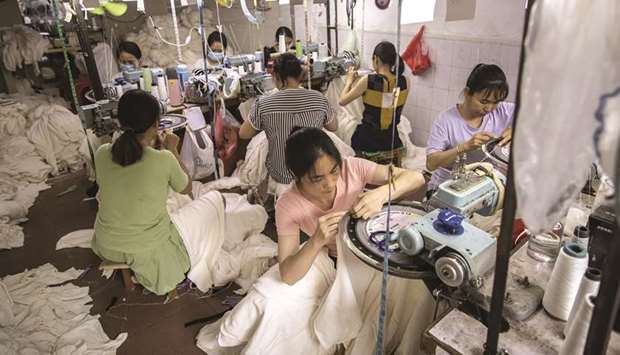
Workers in a textile workshop in Dongguan, China. Since normal circumstances disappeared with Covid-19 many months ago, the growth and manufacturing reports from China, India, Brazil and South Africa that are due this week are potentially less decisive for traders than the simple fact that central banks still have the markets’ back.