


It takes a community to communicate effectively
As Qatar nears phase four of its gradual lifting of Covid-19 restrictions, it continues to maintain one of the lowest Covid-19 mortality rates in the world, and the number of daily confirmed cases has decreased since July.
The government has regularly attributed the low number of fatalities to the quality of its healthcare system, proactive and extensive testing, and its young population.
HE Lolwah Alkhater, Assistant Foreign Minister and spokesperson for the Supreme Committee for Crisis Management, has additionally attributed Qatar’s low Covid-19 fatality rate to aggressive awareness campaigning in nine different languages.
Language and cultural barriers are quite serious in Qatar where blue-collar migrant workers form a significant part of Qatar’s population, yet often do not speak the official language Arabic or English and may face illiteracy as well. While migrant workers faced high rates of infection during the early stages of the pandemic, Qatar’s multilingual campaigning, alongside preventative and precautionary measures in workers’ accommodations and project sites, helped contain the spread of the virus.
In a comprehensive study, which will be published in a reputable international journal, we identified three major factors that played a key role in the success of the campaign. They include (1) use of migrant languages such as Urdu, Malayalam, Nepali, Bengali, and Tagalog in printed posters and fliers; (2) use of radio stations in delivering awareness messages in an oral form; and (3) mobilisation of community and religious leaders.
1. Multilingual Covid-19 awareness posters and fliers
Within less than two weeks of the first confirmed case of Covid-19 in Qatar, Qatar Media Corporation (QMC) launched a Covid-19 awareness campaign on social media, particularly targeting community members who do not know Arabic or English. Different departments of the government, namely the Ministry of Interior, Ministry of Public Health, Hamad Medical Corporation, and QMC worked on the multilingual awareness campaign.
In an interview with Faisal Abdulhamed al-Mudahka, Editor-in-Chief of Gulf Times and assistant director of QMC, he informed us how he realised that English is not really an international language understood by everyone and miscommunication about the virus in the early stages convinced him that an aggressive campaign in the languages of workers was needed. Qatar’s ministries published a number of printed awareness posters and fliers in languages beyond Arabic and English, such as Hindi, Urdu, Malayalam, Nepali, Bengali, Sinhalese, Tagalog, Pashto, Indonesian, and Tamil.
*Covid-19 awareness poster in nine languages on Ministry of Interior’s Facebook page
2. Multilingual messages delivered orally through radio stations
Al-Mudahka stressed how important it was to partner with migrant language radio stations to deliver the correct information to workers since many of them face literacy issues.
QMC worked closely with Radio Olive 106.3 FM, Suno Malayalam Network 91.7 FM, Qabayan Radio 94.3 FM, Radio Malayalam 98.6 FM, and Urdu Radio FM 107.
They launched a health awareness campaign “Come Together, Overcome Together” in Hindi, Nepali, Tagalog, Malayalam, Sinhalese, and Urdu.
A new Bengali language channel was also launched on 95.3 FM to assist the campaign as there did not previously exist any radio stations for Bengali speakers.
Although these stations are private and rely on advertisement, the station managers of Radio Olive and Suno Malayalam Network said they saw it as part of their corporate social responsibility. Radio Olive and Suno Network shared with us their audio clips in ten languages including Bengali, English, Hindi, Tagalog, Kannada, Malayalam, Nepali, Pashto, Sinhalese, and Urdu that played on air. Multilingual messages were prepared by their radio jockeys (RJs) in collaboration with community members. They were aired from March 11 until the end of May from 6am until 12am every hour. Radio Olive and Suno Network also did something unique; they sent these audio clips to their 40,000 listeners signed up for their WhatsApp programmes.
Malayalam 98.6 FM had a similar approach to the dissemination of health information to its listeners. In addition to Malayalam, the language of their FM channel, they aired Covid-19 awareness material in Tamil, Bengali, Sinhalese, English, and Arabic. During the peak times of the virus, messages in the above six languages were aired every hour. Radio stations with their RJs also partnered with the government to take the message directly to people using vans fitted with public announcement systems and RJs got out of their vans and spoke to people in their own languages.
*Government partnering with Radio Olive 106.3 FM and Radio Malayalam 98.6 FM
3. Collaboration with social, religious, and media personalities
While people received Covid-19 awareness messages in their own languages, the government still faced challenges with compliance of precautionary measures. Understanding a message does not automatically mean accepting a message. The government realised that in addition to use of migrant languages, community leaders could play a critical role not only in delivering health-related information to their communities but also creating trust needed for strict compliance. For example, one challenge faced early on was that many Muslim workers continued to gather for Friday congregational prayers on rooftops and other open spaces even after social gatherings were banned. Consequently, the government partnered with prominent religious leaders such as Sheikh Abdulbasith Omri, who created messages in Urdu clarifying the religious ruling about congregational prayers during times of pandemic. The government also partnered with celebrities such as Aditya Menon and social media influencers from different expatriate communities such as RJ Obaid Tahir who works for Urdu Radio FM 107. He repackaged government awareness messages into his own Urdu videos and summarised the announcements of the press conferences held by Qatar’s Supreme Committee on his social media. His videos had wide reach.
Hamad Medical Corporation and the Ministry of Interior also shared numerous videos on their social media pages of different community members speaking about various aspects of Covid-19.
*Community-centred approach to Covid-19 communication
The Covid-19 pandemic and attempts to swiftly contain it have shown the importance of effective communication, as lack of awareness about information can contribute to the spread of the virus, leading to more infections and deaths.
Qatar employed multiple languages via traditional media, digital and social media, but also realised an important lesson along the way; while the different languages and modes of communication were important in spreading awareness, equally critical, if not more, was who carried the information and in what forms.
Printed words were not sufficient, especially because of the low literacy levels of blue-collar workers, but also because printed words are detached from the speakers and the social trust they create.
What was truly effective was engaging an army of volunteers and activists to spread awareness about Covid-19, such as collaborations with radio stations, community and religious leaders, and social media influencers.
Al-Mudahka was clear that the government should not wait for a disaster to happen to involve different communities to establish clear and effective channels of communication. Given the large number of workers speaking different languages in Qatar, he suggests developing community media for the successful dissemination of information to the people. As many countries around the world face possible second waves of infections, a community-centred multilingual approach to Covid-19 can help develop awareness among people in languages that they understand and trust, which enhances acceptability and compliance.
*Rizwan Ahmad is an associate professor of sociolinguistics in the Department of English Literature & Linguistics at Qatar University. Twitter: @rizwanahmad1
*Sara Hillman is an assistant professor of English in the Liberal Arts Program at Texas A&M University at Qatar. This research was partially funded through Texas A&M University at Qatar’s Covid-19 Response Programme. Twitter: @sarapatra
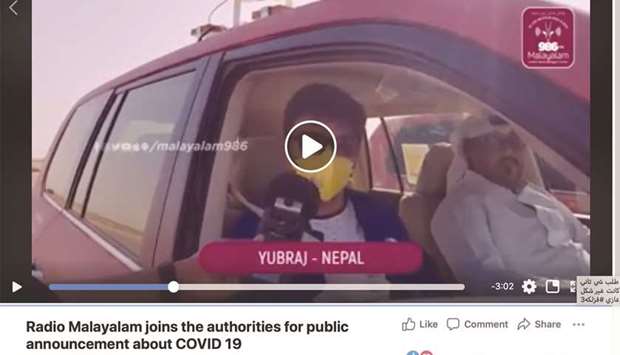
Government partnering with Radio Olive 106.3 FM and Radio Malayalam 98.6 FM