


After exploding in most populous cities like Delhi and Mumbai, Covid-19 is now rearing up in large and small cities, which experienced migration from these megapolises.
Experts have expressed concern as the concentration of health personnel and infrastructure is only limited to large urban centres, and this is apparent in Delhi’s next-door neighbour Uttar Pradesh, where many cities continue to struggle in tackling the coronavirus infections.
Doctors suggest since the epicentre of the viral infection is likely to shift, it would be appropriate to replicate successful large-scale testing and contact tracing models in small cities.
For example in Agra, Uttar Pradesh, the state Health Department will conduct an extensive sero-survey to find the percentage of population with antibodies against Covid-19.
In the region, Agra has reported 36 new cases in the past 24 hours, Mathura 100, Firozabad 42, Mainpuri 31, Etah 31 and Kasganj 21.
In Agra, the total number of cases so far is 2,481, and it has 152 containment zones.
Jyoti Goyal, head of Internal Medicine at Nayati Medicity in Mathura, said: “Big cities like Delhi controlled Covid-19 very well through robust testing. Be it RT-PCR, antigen, antibody tests, Delhi has done testing widely. On the contrary, in Agra and Mathura, testing is extremely restricted. The authorities have not evolved their strategy, as Covid-19 has evolved. They need to replicate Delhi’s testing and contact tracing in small cities.”
Goyal said that against the backdrop of the ongoing rainy season, healthcare workers in small cities may get confused whether an illness is Covid-19 or any other form of tropical illness.
Uttar Pradesh, with 182,453 cases, is also among the five most-affected states, accounting for 7.2% fresh Covid-19 cases.
The total number of cases in the northern state is 6.1% of the national burden and 2,867 lives have been claimed by the infection.
Professor K Srinath Reddy, president of the Public Health Foundation of India, said as large cities are recovering from the epidemic, smaller cities and towns are becoming the zones of active infection.
“If the initial experience of being relatively free from the virus leads to complacency and careless behaviour, the virus will spread rapidly even in these areas. We need to step up public health measures and motivate people to adopt safe practices like physical distancing, avoiding crowded events, using masks outside home and frequent hand washing. Engaging local community networks and influencers will help in promoting safe behaviours,” he added.
Reddy said wide-scale testing may pose challenges, however, clinical assessment as well as history of close contact with a Covid-19 affected person or history of recent travel from a highly infected region will help to assign high, medium or low probabilities of the infection.
“Because of false negatives and false positives associated with test results, even laboratories advise that the diagnosis should not depend on testing alone but take into account clinical and contact information,” he said.
While 769 cases were reported from state capital Lucknow, there were 363 cases in Gorakhpur and 300 cases in Prayagraj, as Uttar Pradesh recorded 5,375 infections on Saturday.
Deepak Dewan, director, Renal Sciences at Regency Superspeciality Hospital in Lucknow, said the number of Covid-19 cases in Lucknow in a population of 3mn, is extremely alarming, and it is apparent that migration from big cities to small cities has contributed towards the spread of the infection.
“In small cities, people are not following infection prevention measures, and social distancing guidelines. If this continues, then chances are very high that infection will spread like a wildfire in small cities. A combination of large-scale testing and contact tracing is the need of the hour,” he said.
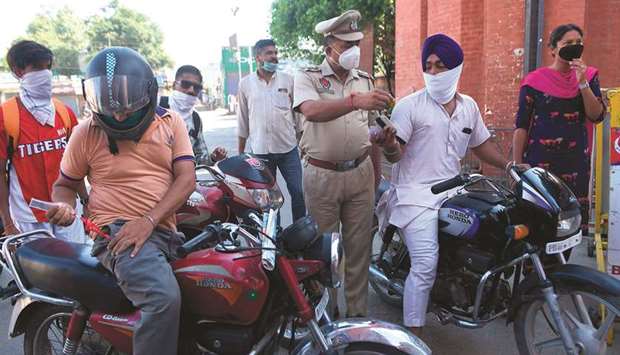
Police check travel passes of commuters after strict lockdown norms for weekends and public holidays were imposed in Amritsar, Punjab. The northern state has ordered daily night curfew in addition to a weekend lockdown.