


The number of new people confirmed to be infected with the coronavirus in Germany spiked again yesterday, at a rate not seen since late April.
The coronavirus causes the Covid-19 respiratory disease.
Over the last 24 hours, health authorities across the country recorded 2,034 new cases, bringing the total number of infections so far to 232,082, the government’s Robert Koch Institute (RKI) for disease control said.
The last time the number was higher was on April 25, when 2,055 new infections were reported.
Nationwide, there has been a large number of smaller outbreaks, many of which are connected to events including large family celebrations, according to an RKI report on Friday.
Additionally, coronavirus cases have been identified in travellers returning from abroad, especially in the younger age groups.
Most of the latest outbreaks are affecting private households and homes for the elderly, according to the RKI.
Outbreaks spread the furthest, however, in care homes and refugee centres, it said.
On average, some 19 people are infected when the virus reaches old people’s homes, while 21 people on average are infected when it reaches refugee centres.
Schools, on the other hand, aren’t leading to major outbreaks at present, the study found, and only a small number of cases can be traced back to restaurants, hotels and offices.
The study underlined the relative safety of meeting outdoors, stating that no or very few outbreaks could be traced back to trips to zoos or picnics.
Germany’s epidemic reached its peak in early April, when cases were rising by over 6,000 daily.
The numbers had been decreasing since late July, but that trend has reversed recently, stoking fears of a second wave of infections.
However, the spike also comes in the wake of a significant rise in testing.
Germany now provides free tests for people coming back from holidays, and as testing rates increase, backlogs have built up, leaving thousands waiting for their results.
Bavaria’s authorities were criticised last week after it emerged that tens of thousands of people had not received their results, including many who had tested positive for the virus.
On Friday evening, a testing centre in Bavaria was closed temporarily after three employees reported symptoms of the virus.
The centre, located on the A3 motorway near Passau and run by Eurofin, a private provider, reopened after an hour, thanks to volunteers.
The Bavarian health ministry is now assessing the situation at the centre and said delays were likely this weekend.
Since the start of the outbreak, according to the RKI, 9,267 people have died in connection with Covid-19.
That was up by seven compared to Friday.
The institute estimates that around 206,600 people have recovered after catching the virus.
Meanwhile, Italy recorded more than 1,000 new cases of the coronavirus in the last 24 hours, the worst daily figure since lockdown was lifted in May, the health ministry reported yesterday.
Officials in Rome said the capital region recorded 215 new coronavirus infections in the same period mainly because of people returning from holiday, the biggest such rise since lockdown in March.
The health ministry said Italy recorded 1,071 new cases of the novel coronavirus in the last day and three deaths, for the first time crossing the threshold of 1,000 infections since May 12.
It marks a relentless uptick in cases in the last few days, from 947 on Friday, 845 on Thursday and 642 on Wednesday.
The figure of 215 for Rome is a record, more than the 208 people were infected in a one-day period on March 28, when Rome had come to a virtual standstill to stop the coronavirus spreading, the capital’s health official Alessio D’Amato said.
“Sixty-one per cent (of the cases) are linked to people returning from vacation,” D’Amato said, almost half the cases were returning from the island of Sardinia.
Sardinia had been spared the first wave earlier this year but D’Amato said the movement of tourists and people partying had helped spread the virus.
Francesco Vaia, director of Rome’s Spallanzani Hospital specialising in infectious diseases, told Italian media that “the solution is to do tests on departing boats, planes and trains. This is the only way to prevent the virus spreading”.
D’Amato said most of those infected were young people who were not showing symptoms and it was urgent to “block the chain of transmission as fast as possible by finding the asymptomatic and averting the spread of the virus among families.
“Be very careful especially with your relatives and the people dearest to you,” he said in an appeal to the young.
He warned them to stay at home and not meet up with people while awaiting test results.
“Don’t feel invincible,” he urged them.
Italy – particularly the northern Lombardy region, the Venice area and Rome – are seeing a resurgence in the virus over the summer.
The Italian government has taken several steps to block the spread, such as closing nightclubs since August 17 and making mask wearing compulsory in busy public spaces between 6pm and 6am.
Since the pandemic erupted, Italy has recorded more than 257,000 cases, including more than 35,000 dead.
The Czech authorities meanwhile recorded 506 new coronavirus cases on Friday, the highest number of new infections in one day since the outbreak began there.
Czechia has so far reported 21,551 confirmed cases of the virus, with 411 deaths, including 19 over the past week.
The Czech government was among the first in Europe to introduce curbs on movement and business as the outbreak took hold.
It began to lift restrictions since May but has reintroduced some measures as cases rose in recent weeks.
Face masks will once more be compulsory on public transport, at health and social care facilities and in state office buildings from September 1, but the government rowed back on a requirement to wear masks in shops, restaurants and common areas of schools.
Outdoor public events including soccer, which starts new league season this week, may be attended by up to 5,000 people, if separated into sections of 1,000, and indoor events can host up to 5,000 in separate sections of 500.
The government plans to further relax restrictions on public events from September.
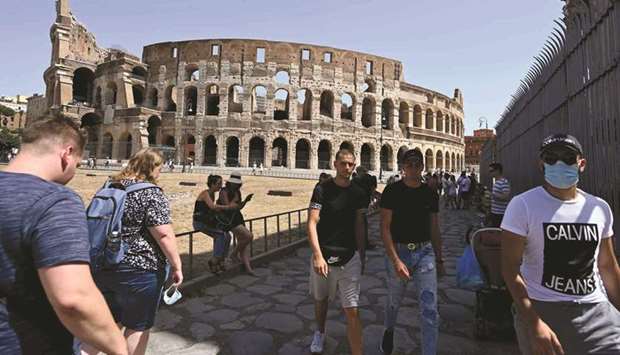
Tourists, with only some wearing face masks, walk outside the Colosseum monument in Rome.