


The proportion of the highest GCSE grades awarded in England this year has jumped by 26%, in the wake of the government’s examinations U-turn, according to figures released by the regulator Ofqual.
Following the government’s decision to scrap calculated grades and replace them with school-assessed grades in most cases, the proportion awarded of grades 7, 8 and 9 – equivalent to the old A and A* grades – awarded to Year 11 pupils rose from 21.9% last year to 27.6% this year.
The proportion of entries awarded the highest grade, 9, also rose from 4.7% last year to 6.6% this year, according to Ofqual.
In all cases the proportion of higher grades awarded would have set new records had they been sat under exam conditions.
Pupils achieving a 4 or above, equivalent to a C or above under the previous measure, also rose substantially from 70% to 79% in England.
In the key subjects, the proportion of 16-year-olds awarded 7 and above in English rose by six percentage points to 23%. The proportion gaining 4 or above rose from 70% to 80% this year.
In maths, the other compulsory GCSE subject, the proportion gaining 7 and above rose from 20% to 24%, and those gaining 4 and above rose from 71.5% to just over 77%. In most cases the results given to pupils yesterday were derived from assessments made by their teachers and schools, known as centre-assessed grades.
But in some cases pupils were awarded a higher grade if it had been given by the algorithm previously used by Ofqual.
Ofqual also released the new, centre-assessed A-level grades being awarded to sixth-formers in England. The proportion of top marks, A* and A, increased 13 percentage points to 38%, while the proportion gaining grade C and above rose to 87.5% from 75.5%.
New figures released by Ofqual also showed that as many as one in four students would have missed out on a C grade or better if the algorithm had been retained in place of A-levels assigned by schools.
Students taking English, and design and technology, were downgraded more frequently than other candidates.
In English, one in five students would have missed out on a C grade or better, based on the algorithm.
One in six students taking history and one in 16 taking maths were marked down below a C using Ofqual’s model.
In Wales the exam regulator Qualifications Wales said its revised GCSE results were “substantially higher” than in recent years. Nearly 26% gained A* or A grades, compared to 18% in 2019.
And 74.5% of students received A*-C grades, compared with 62.8% last year.
Qualifications Wales also revealed higher A-level results, following the decision by the Welsh government to also use school-level assessments.
“Our best estimate at this stage of revised 2020 A-level results in Wales at cumulative A* to A is 41.3%, compared to 29.9% when results were released on August 13, and 27% in 2019,” a spokesperson for Qualification Wales said.
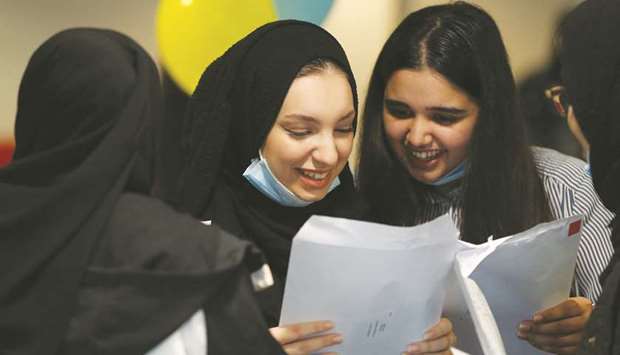
Students react as they check their GCSE results at Ark Academy in London yesterday.