


Reuters/London
Earlier this year, Tottenham lawmaker David Lammy pleaded for attention to his struggling constituency after official figures showed it had the highest jobless count in London and the 10th highest in Britain.

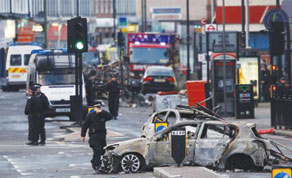
Police officers investigate in Tottenham
Last weekend, he got it — though not in the way he had hoped — after a protest over the police shooting of a 29-year-old black man sparked some of the most violent riots in the capital in years.
Politicians, including Lammy, have been quick to blame the riots and looting on Saturday night and “copycat” outbreaks of violence elsewhere in London on Sunday on small groups of criminals.
But locals and commentators warn that high levels of long-term and youth unemployment and cuts in services like youth centres in places like Haringey — the borough where Tottenham sits — are creating a tinder box for unrest.
Lammy had hoped the constituency could be made an enterprise zone to attract investment.
“Haringey is one of the poorest places in the UK, in the heart of bustling London,” said professor Mike Hardy, executive director of the Institute of Community Cohesion, which researches and develop policies on integrating communities.
“This is not about race, faith and class pure and simple... One of the most powerful drivers is about the haves and have nots... It’s about those who are excluded.”
Some 6,000 people in Tottenham, or 8% of the adult population, are claiming job seekers allowance, more than double the UK average. One fifth of those claiming are under 24.
Hardy said high unemployment, coupled with cuts in “cohesion instruments” like sports and community groups, created environments where people felt like outsiders in their own society.
“People learn to live outside the norms... where they have no buy-in to the structures we expect.”
Many of Britain’s most deprived communities have worked hard to build support networks within communities, and with formal structures such as the police, in the wake of riots during the 1980s, including one in Tottenham in 1985. At that time, a police officer was killed during riots sparked by the death of a woman whose home was being searched by police.
Similarly, Saturday’s protests, which Lammy said were later “hijacked” by criminals who set fire to buildings, looted shops and attacked police officers, were triggered by the killing of a 29-year-old black man by police last week.
Some have blamed the police for acting too slowly and not listening properly to community leaders who warned of potential violence, but local officials and community groups say a lack of trust in the police is not the key driver for unrest.
“Relationships between the local police force and the community have improved dramatically since the Broadwater Farm riots of 26 years ago,” Lammy wrote in a newspaper column.
“One local sergeant can name almost every teenager on the estate on his beat and they know him.”
The bigger issue is a lack of purpose and lack of jobs, they say.
“It’s unacceptable. They shouldn’t have started looting,” said Erika Lopez, a 19-year-old university student and volunteer with Haringey’s Young People Empowered, a youth network in the borough.
But she painted a telling picture of an area in which services face more and more cuts, with summer activities for young people like cooking, music and sports all slashed.
“Especially during the summer we have nothing to do... It feels like they’ve taken away the things that matter,” she said.
Britain has embarked on an unprecedented level of spending cuts in an effort to drive down its budget deficit, with local councils slashing a host of services from elderly care to libraries.
Haringey’s youth services budget was cut by 75% this year, as part of £84mn pounds in budget cuts planned by the council over the next three years.
On top of youth unemployment another worry is long-term unemployment, which has also increased sharply in Britain and is described by one leading think-tank as “worryingly high”.
In Brixton in south London, home to some of the most violent riots during the 1980s sparked by racial tensions between police and locals at a time of soaring unemployment, the picture is similar.
“I’ve got bricklaying skills, got plastering skills but everywhere I am looking is just, like, no vacancies. You go into a job centre and they can’t even get you a job — that’s what they are there for,” said Michael, 31, an unemployed building worker.
“I’ve not got sympathy for kids smashing up things, but people don’t know what it’s like if you grew up in a home without a dad around you or your parents can’t get a job.”
While Tottenham residents barricaded themselves indoors against the violence on their streets, the prime minister, deputy prime minister and interior and finance ministers were enjoying holidays in places like Italy, Switzerland and California. The London mayor was also on holiday.
Tim Hardy, of left-wing blog Beyond Clicktivism, said: “I think there’s a real anger about the way in which this is happening while our leaders are on frankly obscenely luxurious summer holidays.”