


Guardian News and Media/London
 |
|
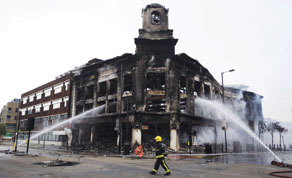
A firefighter walks past a burnt down building after a night of riots in Tottenham yesterday |
As questions were asked about the level of policing, Commander Adrian Hanstock said a peaceful vigil by the family of 29-year-old Mark Duggan, who was fatally shot by officers in the area on Thursday, had been “hijacked by mindless thugs” and that the situation had “escalated out of all proportion”.
Twenty-six police officers suffered injuries, with eight receiving hospital treatment. Two remained in hospital yesterday. Three members of the public also required medical attention, with two taken to hospital.
Forty-two people have been arrested for offences including violent disorder, burglary and theft following the torching of buildings, two police cars and a bus, and the ransacking and looting of shops in both Tottenham and nearby Wood Green.
The violence followed a demonstration by members of the community outside Tottenham police station to demand “justice” for the family of Duggan, a father-of-four, who was shot after police stopped the minicab he was driving in.
The Independent Police Complaints Commission (IPCC) is investigating the incident, which also saw a police officer shot, the bullet reportedly lodging in his police radio and leaving him with minor injuries.
Hanstock said the death was “extremely regrettable”. He said it was “absolutely tragic that someone has died, but that does not give a criminal minority the right to destroy businesses and people’s livelihoods and steal from their local community”.
“There was no indication that the protest would deteriorate into the levels of criminal and violent disorder that we saw,” he added.
As soon as the situation became apparent, riot police were deployed and support called in from other forces as officers were “subjected to bottles, petrol bombs and other missiles”, he said.
Police had kept a “dignified” presence at the vigil, and there was nothing to indicate it would be “anything other than a peaceful demo”, he added.
But community leaders had warned of tensions following Duggan’s death. Nims Obunge, a street pastor who was with the Duggan family at the police station protest, said the family and the community needed answers.
“I was here (at the police station) for five hours before this incident kicked off. Someone died on Thursday, a man was shot in our community and the community cried out for justice,” he said.
The IPCC, which took over the investigation after the shooting, said it had been in contact with the family. Scotland Yard sources said they were not allowed to communicate with the family because the inquiry was being handled by the IPCC.
The IPCC confirmed that the first time the Duggan family had been taken to identify his body or see it to pay their respects had been on Saturday afternoon, some 36 hours after his death.
“The fact is that someone was killed in our community and the family came over here to say: ‘Give us answers as to why this happened,’” Obunge said.