


 |
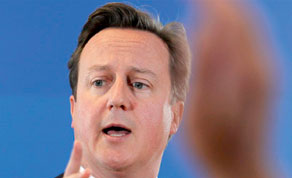
| Prime Minister Cameron |
Britain’s deficit-slashing austerity measures have been “vindicated” by Standard & Poor’s move to slash Washington’s top AAA credit rating, a government spokesman said yesterday.
“Abandoning our deficit reduction plans would put Britain back in the international firing line—and we are not in that firing line because our credit rating is secure,” said the spokesman for Prime Minister David Cameron’s Downing Street office.
The comments came after Standard & Poor’s cut the United States’ top rating down a notch, to AA+, for the first ever time, technically signalling that the country’s reliability for paying its debts had decreased.
Britain’s Conservative-Liberal Democrat coalition government, which rose to power last year, has sought to axe public spending and hike taxes in order to slash a record deficit and preserve the nation’s top-level AAA credit rating.
“Because of the decisions the government has taken to deal with our debts and support a sustainable recovery, Britain’s credit rating has been reaffirmed, helping to keep the cost of borrowing down for taxpayers, homeowners and businesses,” a Treasury spokesman added yesterday.
But the opposition Labour party, which was ousted from power by the coalition in May 2010, argued that British finance minister George Osborne has cut spending too quickly and too deeply.
“The problem in Britain is that George Osborne’s plan is not working,” said Labour finance spokesman Ed Balls in a statement issued in response to ongoing market turmoil and the US credit downgrade.
“By trying to go too far and too fast, confidence has been knocked and last year’s recovery has been choked off.”
But Business Secretary Vince Cable said Washington’s downgrade was “entirely predictable” after lengthy US political wrangling to lift the debt ceiling, adding that Britain’s rating was safe due to his government’s swift action.
“This was an entirely predictable consequence of the mess that the Congress created a few weeks ago when they couldn’t agree on lifting the debt ceiling,” he told Sky News. “But they have now agreed that, and the United States’ position is pretty secure,” added Cable, who is a Liberal Democrat.
“What it tells us about the wider picture is that financial markets are now focussing on the credit worthiness of governments. Three years ago it was on the banks and the banks’ stability, and now it’s on government debt.
“And that’s why the UK is in a fairly good position. The markets perceive that we have got a stable government... and we are getting on top of the deficit problem and we have got a very clear programme to deal with it.”
Turning to the eurozone debt crisis, which is currently threatening to engulf Italy and Spain, he added: “The eurozone countries have agreed a broadly sensible strategy to deal with the weakness of southern Europe.
He said they had accepted that Greece was solvent as long as some of its debts were written off.
“They have got to have a wider fund of money and more liquidity to help countries like Greece and Spain if they have an attack on their confidence.”
Questioned about whether Italy would default, he said: “I don’t think anybody really expects Italy to default. It’s in a rather different position to Greece.
“There is a problem of confidence, they may need access to this emergency fund of money. But I think that the prospect of Italy defaulting, let alone leaving the eurozone, are very far fetched.”
Although Britain is not a member of the eurozone, the country has been rocked by its own deficit tensions, forcing its coalition government to slash public spending and lift taxation.
Cable is a key Liberal Democrat member of the Conservative-led coalition administration which rose to power in May 2010.