


 |
The entry of Boeing 777X, the world’s largest twin-engined jet, into service has been delayed until 2022. Boeing also said it would again reduce the combined production rate of the 777
and 777X jets to two planes per month in 2021.
and 777X jets to two planes per month in 2021.
Boeing’s commercial airplanes operating profit was hit by $845mn in abnormal production costs on 737 and factory closures related to Covid-19 fears. Boeing also logged $468mn in severance expenses related to reducing its roughly 160,000 workforce by 10%, saying yesterday deeper cuts were possible. “We’ll have to further assess the size of our workforce,” Calhoun told employees in a memo yesterday.
Boeing also declared the end of Boeing 747 production in 2022, and will reduce 787 Dreamliner production in 2021 to six jets per month. The US manufacturer is also considering the consolidation of its two 787 assembly lines amid the fall in demand due to the ongoing Covid-19 pandemic.
Singapore Airlines (SIA) reported yesterday (July 29) a US$815mn net loss in the quarter ended June 30, its largest quarterly loss in history. Revenue for the group plunged 79.3%, while expenditure dropped 51.6%. "Demand for air travel evaporated as travel restrictions and border controls were imposed around the world to contain the spread of the virus." the airline explained in a statement. There was also a 99.5% decline in passenger numbers for the Singapore Airlines group as a whole during this period.
Elsewhere, a new study named “Airport risk of importation and exportation of the Covid-19 pandemic” has shown the level of exportation/importation of the disease at the beginning of the pandemic. It shows that some airports, including airports in China and Iran, had a higher risk of both importation and exportation than other airports, while some airports in Europe, especially Italy, had a higher risk of exportation than of importation.
Moreover, the US had more airports with a relative risk of importation than with relative risk of exportation. This means that although the US did not show a high number of cumulative confirmed cases relative to the population on March 14, 2020, it had potential relative risk to import the pandemic disease.
The top five countries with relative risk of importation of Covid-19 were South Korea, China, UK, Iran, and Spain, and those with exportation relative risk were Italy, South Korea, China, Iran, and Spain. It also clearly indicated that not only China, Europe, Middle East, and East Asia, but also various other countries such as the US, Australia, northeast Asian countries, and Latin America are exposed to risk to some extent.
The study found that at the pandemic stage, the risk of exportation is as important as the risk of importation.
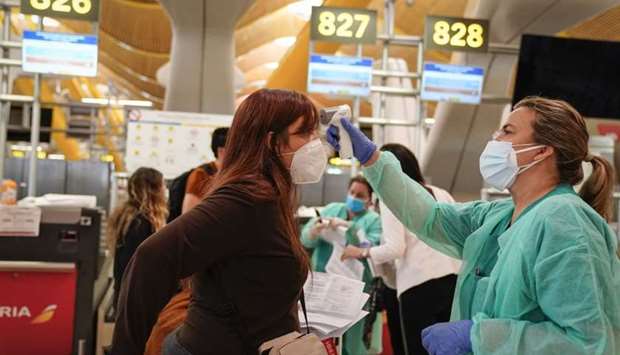
Airline leaders view Covid-19 testing as one of the few strategic options that has the ability reduce further damage to the already suffering global air travel sector. Ideally, testing would be completed in a rapid, reliable way prior to departure. The goal is for an airline to be able to declare a flight as 'sterile' or 'Covid-free'.
In UK, leading travel and airline industry figures have urged the prime minister to replace blanket quarantine measures with regional travel corridors.
In a letter to Boris Johnson, they said the 14-day quarantine for people coming from Spain had caused disruption. It was "the latest significant blow to a sector which now risks being permanently scarred", they added. They called for quarantine-free travel to areas unaffected by any spike in coronavirus cases. This would include not just Spain, but other key markets for trade and tourism, such as the US and Canada. "We are in a situation where the government is advising against travel to areas of Spain that have lower rates of Covid than the UK," the letter said. "We urgently request a meeting with you to discuss the challenge facing our sector and our proposed ways forward," the letter concluded.
The letter had nearly 50 signatories, including British Airways chief executive Alex Cruz, Heathrow chief executive John Holland-Kaye.
Under current rules, those arriving in the UK from certain countries, including all countries of the Middle East, must self-isolate for 14 days. The government has indicated that it is keeping all quarantine measures under review.
Many countries, such as Iceland, offer travellers a choice on arrival if they have stayed in areas with high virus levels. Anyone entering must either self-quarantine for 14 days or get tested for Covid-19. Germany is also preparing compulsory tests at its airports for anyone arriving from a high-risk country. France has this week implemented mandatory testing for arrivals from 16 countries, including passengers arriving on flights from the USA, South Africa, Brazil, the UAE, Kuwait, Qatar, Algeria, Mexico, Serbia, Peru, among others.
For countries with a high rate of Covid-19 infection, airlines consider testing as an added layer of measures to push down the risk of carrying passengers who have coronavirus. We’re expecting to see further testing policies added at several airlines over the coming weeks.
Boeing also declared the end of Boeing 747 production in 2022, and will reduce 787 Dreamliner production in 2021 to six jets per month. The US manufacturer is also considering the consolidation of its two 787 assembly lines amid the fall in demand due to the ongoing Covid-19 pandemic.
Singapore Airlines (SIA) reported yesterday (July 29) a US$815mn net loss in the quarter ended June 30, its largest quarterly loss in history. Revenue for the group plunged 79.3%, while expenditure dropped 51.6%. "Demand for air travel evaporated as travel restrictions and border controls were imposed around the world to contain the spread of the virus." the airline explained in a statement. There was also a 99.5% decline in passenger numbers for the Singapore Airlines group as a whole during this period.
Elsewhere, a new study named “Airport risk of importation and exportation of the Covid-19 pandemic” has shown the level of exportation/importation of the disease at the beginning of the pandemic. It shows that some airports, including airports in China and Iran, had a higher risk of both importation and exportation than other airports, while some airports in Europe, especially Italy, had a higher risk of exportation than of importation.
Moreover, the US had more airports with a relative risk of importation than with relative risk of exportation. This means that although the US did not show a high number of cumulative confirmed cases relative to the population on March 14, 2020, it had potential relative risk to import the pandemic disease.
The top five countries with relative risk of importation of Covid-19 were South Korea, China, UK, Iran, and Spain, and those with exportation relative risk were Italy, South Korea, China, Iran, and Spain. It also clearly indicated that not only China, Europe, Middle East, and East Asia, but also various other countries such as the US, Australia, northeast Asian countries, and Latin America are exposed to risk to some extent.
The study found that at the pandemic stage, the risk of exportation is as important as the risk of importation.
Airline leaders view Covid-19 testing as one of the few strategic options that has the ability reduce further damage to the already suffering global air travel sector. Ideally, testing would be completed in a rapid, reliable way prior to departure. The goal is for an airline to be able to declare a flight as 'sterile' or 'Covid-free'.
In UK, leading travel and airline industry figures have urged the prime minister to replace blanket quarantine measures with regional travel corridors.
In a letter to Boris Johnson, they said the 14-day quarantine for people coming from Spain had caused disruption. It was "the latest significant blow to a sector which now risks being permanently scarred", they added. They called for quarantine-free travel to areas unaffected by any spike in coronavirus cases. This would include not just Spain, but other key markets for trade and tourism, such as the US and Canada. "We are in a situation where the government is advising against travel to areas of Spain that have lower rates of Covid than the UK," the letter said. "We urgently request a meeting with you to discuss the challenge facing our sector and our proposed ways forward," the letter concluded.
The letter had nearly 50 signatories, including British Airways chief executive Alex Cruz, Heathrow chief executive John Holland-Kaye.
Under current rules, those arriving in the UK from certain countries, including all countries of the Middle East, must self-isolate for 14 days. The government has indicated that it is keeping all quarantine measures under review.
Many countries, such as Iceland, offer travellers a choice on arrival if they have stayed in areas with high virus levels. Anyone entering must either self-quarantine for 14 days or get tested for Covid-19. Germany is also preparing compulsory tests at its airports for anyone arriving from a high-risk country. France has this week implemented mandatory testing for arrivals from 16 countries, including passengers arriving on flights from the USA, South Africa, Brazil, the UAE, Kuwait, Qatar, Algeria, Mexico, Serbia, Peru, among others.
For countries with a high rate of Covid-19 infection, airlines consider testing as an added layer of measures to push down the risk of carrying passengers who have coronavirus. We’re expecting to see further testing policies added at several airlines over the coming weeks.
* The author is an aviation analyst. Twitter handle: @AlexInAir