


After Delhi seemed to be overwhelmed by the coronavirus catastrophe, a respite may be in sight with the number of infections beginning to decline consistently, and it appears that the curve may plateau soon.
According to an expert, one of the crucial factors which helped Delhi tide over the health crisis is aggressive testing.
But Dr Neeraj Nischal, Associate Professor in the Department of Medicine at the All India Institute of Medical Sciences (AIIMS) emphasised that people should not lower their guard against the viral infection.
“It is clear that the policy of test, trace, isolate and treat cases is bound to decrease the number of cases. This is exactly what is happening in Delhi, as cases have begun to decline,” he told IANS.
“I would like to add the other crucial reason for decline in cases is due to the participation of the people. Most people diligently followed social distancing norms, which eventually helped,” he added.
Delhi Chief Minister Arvind Kejriwal, in a recent statement, said: “We have increased testing in Delhi. Initially, on testing 100 people, around 31 were found to be corona positive, and today, only 13 out of 100 people are found to be corona positive. These things show that the situation is under control, and is not as terrible as it was one month back.”
Asked about the possibility of herd immunity against the backdrop of the recently conducted sero-surveillance in Delhi, Nischal said though cases have begun to decline, people should avoid making visits to malls or forming large crowds.
“People should not lower their guard. To develop herd immunity, a large section of the population has to be infected, which has not happened in Delhi yet,” he said.
In Delhi, out of the 11 districts, eight have sero-prevalence of more than 20%.
In the central, northeast, north and Shahdara districts, the sero-prevalence is 27%.
Delhi’s southwest area has 12.95% sero-prevalence, the least in the city, followed by south and west Delhi at 18.61% and 19.13%, respectively.
In the period between June 27 to July 5, it was found that 24% people developed antibodies from virus, which means that 24% people have got infected and then recovered.
“We don’t know for sure for how long these antibodies will last. It is a matter of debate how protective these antibodies are. Therefore, it is essential that people continue to take precautions,” Nischal said.
He said if people do not follow social distancing, then the city could face another surge in cases.
“The future of vaccines is bright. But to see that future, we have to survive the present. Social vaccine is the need of the hour. Maintaining social distance, wearing face mask, maintaining cough etiquette and hand hygiene will help in saving people not only from Covid-19, but also from other infections.”
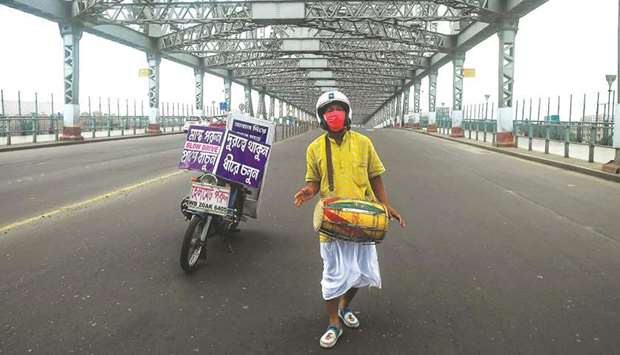
An unemployed musician sings and dances with his drum to create awareness about the spread of the Covid-19 on the Howrah Bridge during a complete lockdown announced by the state government, in Kolkata yesterday.