


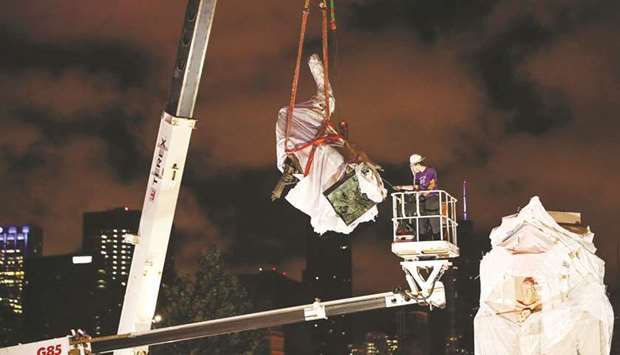
Not all Italian American leaders in Chicago are on board with the decision, but it has received the blessing of some groups, sources said.
By taking the statues down, Lightfoot may draw criticism from those who believe she caved to activist demands.
Later yesterday morning, the mayor’s office released a statement saying that she had both statues “temporarily removed...until further notice.”
“This step is about an effort to protect public safety and to preserve a safe space for an inclusive and democratic public dialogue about our city’s symbols,” the statement said.”In addition, our public safety resources must be concentrated where they are most needed throughout the city, and particularly in our south and west side communities.”
Lightfoot’s abrupt move in the dark of night was an about-face for the mayor, who has opposed taking down statues of the Italian explorer on the grounds that it would be erasing history.
The mayor’s office statement yesterday morning said that the city would soon announce “a formal process to assess each of the monuments, memorials, and murals across Chicago’s communities, and develop a framework for creating a public dialogue to determine how we elevate our city’s history and diversity.”
Crews arrived at Grant Park sometime around 1am and began the process of bringing down the monument honouring Columbus a little afterward.
A couple dozen people cheered from across the street and passing cars honked as the statue came down at about 3am yesterday morning. It was not immediately clear where the statues were taken.
Reports from television stations showed the statue in Arrigo Park, 801 S Loomis Street, in Chicago’s historic Little Italy neighbourhood, was removed a few hours after the downtown statue.
The Grant Park removal capped off an at-times surreal evening.
Late Thursday, Chicago Fraternal Order of Police president John Catanzara made his way to the downtown statue wearing an “Italia” T-shirt. He lounged around, talking with cops, criticising Lightfoot, and promising there would be a pro-police protest there today even if the statue stayed in place.
He also got into debates with anti-Columbus protesters, some of which grew heated.
Ald. Brian Hopkins, 2nd, whose ward includes parts of downtown, said the mayor decided to remove the statue “unilaterally.”
The removal also drew comparisons from Ald. Raymond Lopez, 15th, to former mayor Richard M Daley’s midnight bulldozing of Meigs Field in March 2003.
Lopez later took to Twitter with his criticism of the mayor’s decision.
“What has become of Chicago? We have a mayor forced into submission by anarchy & mob-rule? No more public process, official discourse, or on-the-record debate,” tweeted Lopez, a frequent Lightfoot critic.
“The lesson learned is that if you want action from Lightfoot, show up en mass at her house & she will cave every time.”
Protesters marched downtown last Friday then headed into Grant Park, where a group of people attempted to take down the statue, similar to what’s happened in other cities across the country.
But chaos followed the protest as officers and demonstrators clashed around the statue.
At least 20 complaints of police brutality were filed against Chicago cops, including one involving activist Miracle Boyd, who said she was hit in the face by a police officer during the skirmish, knocking out at least one of her teeth.