


European Central Bank governors held back from topping up their vast pandemic stimulus to the eurozone economy yesterday, leaving the spotlight firmly on government leaders to pick up their share of the load with a recovery plan.
Policymakers left key interest rates as well as virus-fighting bond-buying schemes worth over €1.3tn ($1.5tn) and massive cheap loans to banks unchanged, a spokeswoman said.
It will be down to ECB president Christine Lagarde to explain why the Frankfurt institution stood pat this month.
She had already hinted last week that the governing council would take a breather to gauge the effectiveness of its measures so far.
“We have done so much that we have quite a bit of time to assess (the latest data) carefully,” she told the Financial Times.
The ECB meeting comes on the eve of a July 17-18 European Union summit in Brussels where leaders will wrangle over a proposed €750bn ($847bn) recovery fund to kickstart the bloc’s battered economy.
Lagarde, who has repeatedly urged governments to underpin central bank efforts with fiscal policy, has called the plan a potential “game changer”. The fund would be financed through joint EU borrowing and consist mainly of grants for the hardest hit member states.
But the proposal is fiercely opposed by Denmark, Sweden, the Netherlands and Austria who want to rein in the spending and insist on loans rather than grants, making agreement this week uncertain.
Crucially, the fund has the backing of German Chancellor Angela Merkel whose own government has ditched its no-new-debt dogma to unleash €130bn in fiscal stimulus for Europe’s top economy.
In Washington, the International Monetary Fund urged governments not to let up, as “the costs of premature withdrawal are greater than continued support where it is needed,” its chief Kristalina Georgieva wrote in a blog post.
This month, “it’s all about fiscal policy and the summit on the European recovery fund,” ING bank analyst Carsten Brzeski told AFP ahead of yesterday’s meeting.
At last month’s governing council powwow, the ECB expanded its pandemic emergency bond-buying scheme known as PEPP by €600bn to €1.35tn, and extended it until June 2021.
The goal of the government and corporate debt purchases is to keep credit flowing and encourage spending and investment in the 19-nation eurozone.
It comes on top of the bank’s already ultra-loose monetary policy of historically low interest rates, cheap loans for banks and a pre-pandemic bond-buying scheme to the tune of €20bn monthly — all designed to bolster economic growth and push up stubbornly low inflation.
The ECB said in June it expected the eurozone economy to shrink by a record 8.7% in 2020 because of the pandemic, before returning to growth in 2021.
Incoming data suggest a rebound is already under way as countries emerge from lockdown and consumption ramps up, but the speed and strength of the recovery remains uncertain.
Lagarde told the FT that the virus-fighting measures taken by the ECB so far have “demonstrated their efficiency, their effectiveness”. Capital Economics economist Jack Allen-Reynolds said he expected Lagarde “to emphasise that the bank will do more if needed” amid growing fears of a possible second coronavirus wave.
The ECB’s next economic growth and inflation forecasts are due in September and policymakers will probably wait until then before deciding on further action, observers say.
“Monetary policy should remain accommodative where output gaps are significant and inflation is below target,” IMF chief Georgieva urged.
ECB board member Isabel Schnabel appears to have started managing expectations for later in the year by suggesting that the bank may not use up its full PEPP envelope, and Lagarde can expect to be grilled on the remark by reporters.
She may also be quizzed on her reaction to the resolution of a long-simmering row in Germany about the ECB’s sovereign bond purchases, which spiralled after the country’s highest court questioned the legality of the stimulus scheme in May.
German lawmakers ended the spat by adopting a resolution earlier this month saying they were satisfied the ECB had demonstrated the scheme’s “proportionality”.
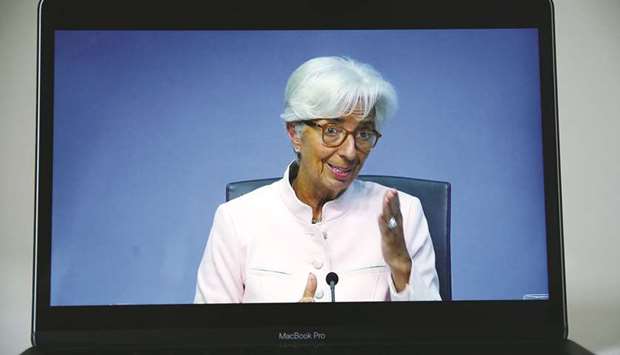
ECB president Christine Lagarde is displayed on a laptop computer during a live stream video of the central bank’s virtual rate decision news conference in Frankfurt yesterday. Policymakers left key interest rates as well as virus-fighting bond-buying schemes worth over u20ac1.3tn ($1.5tn) and massive cheap loans to banks unchanged.