


Agencies/Belfast
At least six police officers were injured in Northern Ireland when around 100 Protestant rioters attacked them with petrol bombs and crashed a hijacked bus into a vehicle, police said.

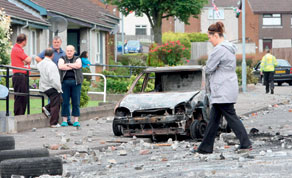
A burnt out car sits amid debris in Ballyclare, Northern Ireland, yesterday
Police fired plastic bullets and used water cannon to control the crowd in the mainly Protestant town of Ballyclare, 20kms north of Belfast, a spokeswoman said.
None of the injuries were life threatening.
The trouble started shortly before midnight after police removed flags of pro-British paramilitary groups flying ahead of the July 12 peak of the “marching season”, a time of annual parades by Protestants which often trigger Catholic protests.
The Democratic Unionist Assembly member for the area, David Hilditch, who is based in Carrickfergus, said the trouble involved “cars, works vans, the hijacking of a bus and damage to people’s personal property”. He said he was aware of at least five vehicles burnt out in Carrickfergus.
The July 12 parades mark the 1690 victory of Protestant King William of Orange over Catholic King James at the Battle of the Boyne, which helped ensure Protestant supremacy in Ireland.
Three decades of fighting between mostly Protestant loyalists who want Northern Ireland to remain part of the United Kingdom and Republicans, mainly Catholics, who want it to form part of a united Ireland tore the province apart during the period known as the “Troubles”.
A 1998 peace agreement paved the way for a power-sharing government of loyalists and Republicans. Violence has subsided over the years, but small dissident armed groups are still active in the province.
In a separate incident, Catholic homes were attacked by around 50 loyalists in the town of Magherafelt, 35 miles west of Belfast.
Shots were fired at a Catholic owned home in Coleraine, but no-one was injured, police said.
Chief inspector Derek MacCamley said: “It appears at this stage that the disorder was caused predominantly by young people who were intent on attacking the police service. The cost to the police service is high but the cost to the community is much higher.