


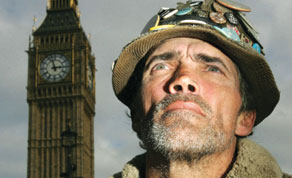
Reuters/London
Peace campaigner Brian Haw, who lived and slept outside the Houses of Parliament in London for a decade to protest against the wars in Iraq and Afghanistan, has died of cancer, his family said yesterday. He was 62.

Haw: prolonged illness
Haw first pitched his tent on a patch of grass over the road from Big Ben and Westminster Abbey in 2001 and became a familiar sight to millions of Londoners and tourists.
His family said in a statement that Haw died on Saturday morning in Germany, where he was being treated for lung cancer. “He left us in his sleep and in no pain, after a long, hard fight,” it said.
The former carpenter, who had seven children, began his protest in response to Western sanctions against Iraq. He continued to camp out after the US-led invasions of Iraq and Afghanistan, in which British forces participated.
With his weathered fishing hat covered in peace badges and anti-war banners, Haw became a well-known symbol of opposition to British and US foreign policy.
He and other campers who joined the protest faced repeated legal attempts by the authorities to force them to leave Parliament Square.
Police raided the camp in 2006, removing placards showing graphic images of dead and mutilated children. Haw said at the time that he was being persecuted for his opposition to the then prime minister Tony Blair’s government.
“This is Mr. Blair’s Britain,” he said in an interview. “You dare to speak, you dare to say it too real, too powerfully, to get through to people, and they smash it all down.”
Artist Mark Wallinger won the 2007 Turner Prize, one of Britain’s most coveted art awards, for a replica of Haw’s anti-war protest.
He recreated the peace banners, flags and plastic shelters inside London’s Tate Britain art gallery for the work, called State Britain.
The Stop the War Coalition, an anti-war group, said Haw was a “thorn in the side of the establishment”.