


It’s no secret that for most of their 2019-20 season, the Atlanta Hawks were one of the worst defensive teams in the NBA.
They finished with the third-worst defensive rating (114.4), gave up 119.7 points per game, tied with the Washington Wizards for the most in the league, and opponents scored an average of 19.5 points off turnovers, the second-most behind the Cleveland Cavaliers. They also gave up 53.6 points in the paint per game, tied for the most with the Cavaliers. The Hawks finished 20-47, 15 games short of a full schedule, since they were more than six games out of playoff contention at the time of the season’s suspension March 11 because of the coronavirus, and thus excluded from the NBA’s plans to restart in Orlando, Florida.
There were games they made poor offensive teams seem like prolific scorers — giving up 143 points in December to the New York Knicks, who score an average of 105.8 points per game, was one of the season’s lowest points. That’s why improving on defense is a must for the Hawks if they want to take a step forward next season.
“It’s crucial,” said John Collins, who himself became a more active defender this season, though he missed 25 games because of a suspension. “Defense pays off, defense pays dividends, defense wins championships, it does all of the above. It’s the ultimate equaliser. I feel like there’s a multitude of examples of teams and people in the league that don’t have a lot of offensive talent, but make a living on the defensive end. I feel like for us, finding a defensive identity will be, like I said, crucial.”
The Orlando Magic, who are No. 8 in the Eastern Conference at 30-35, are a decent example of the group Collins is referring to, teams whose defense is often the difference-maker as opposed to elite scoring.
One big step already has been taken to improve the Hawks’ defense, and that’s the addition of center Clint Capela, though coach Lloyd Pierce has made it clear it’s not Capela’s job to be a savior on defense.
Pierce thinks the Hawks will improve as a whole as their main group gets more playing time together: last season, their “Core Five” group of Collins, Trae Young, Kevin Huerter, Cam Reddish and De’Andre Hunter played just 205 minutes together, with a defensive rating of 111.8 and offensive rating of 117.9 (net 6.1).
“One of the areas that each guy has to continue to grow is defensively,” Pierce said. “When you add in rebounding, when you add in certain lineups playing well together and getting that experience, that’s all part of the growth. So Clint obviously, as we talked about, that was a need for us at the trade deadline because it addressed a few needs, but it still comes down to each guy individually taking part in their growth and their improvement, and we’ll do that. We’ll be better as a unit when we’re all able to play together.” The ‘Core Five,’ what we’re excited about is the amount of opportunity and what they showed when they were able to play together, but that still is a very limited sample size. And so that’s going to help us defensively, that’s going to help us offensively, that’s going to help us as a unit.”
On offense, the Hawks were up-and-down (No. 16 with 111.8 points per game, No. 23 field-goal percentage at 44.9%, No. 30 in 3-point percentage at 33.3%), but they often tried to outscore opponents instead of consistently defending, Huerter said, which is a mindset that needs to change.
“It’s very easy for us, sometimes, to try and outscore people,” Huerter said. “We can score, I feel like, with anybody and we can put up a lot of points. But we didn’t always go back and compete on the other end. It was, teams would score, I don’t think we took enough pride in (playing defense), and just try to go back and score more than them on the other end. So in a lot of ways, it’s a change in mentality of winning teams play defense.”
The Hawks are capable of competing more on defense, Huerter thinks, as there were times they got clutch stops (shutting down DeMar DeRozan at the end of their win in San Antonio is prime example), it’s just a matter of being more consistent on that end.
Young, who started in the All-Star game at age 21 and was the fourth-highest scorer in the league (29.6 points per game) at the time of the season’s suspension, carried the Hawks with his skills on offense, but often is a liability on defense, ranking last among point guards in ESPN’s defensive real plus-minus (-3.12), which marks “a player’s estimated on-court impact on team defensive performance, measured in points allowed per 100 defensive possessions.” Young ranks second among point guards in offensive real plus-minus with a 4.42 (Steph Curry is at 4.48 but played in only five games because of injury), so all in all, ESPN has his real plus-minus (a “player’s average impact in terms of net point differential per 100 offensive and defensive possessions”) at 1.10.
For Young’s part, he listed conditioning as one of the things he’ll be working on this offseason, so he can compete better on both ends.
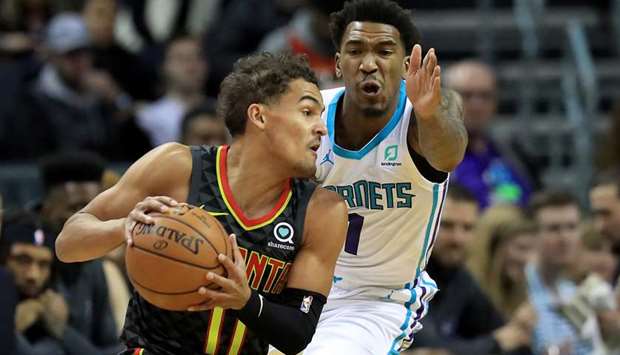
Malik Monk (right) of the Charlotte Hornets tries to stop Trae Young of the Atlanta Hawks during their game at Spectrum Center on December 8, 2019. (TNS)a