


Indians yesterday burned portraits of Chinese President Xi Jinping as families cremated some of the 20 soldiers killed in hand-to-hand fighting with Chinese troops in a disputed mountainous border region.
Troops remained on alert at the Galwan Valley in the Ladakh region of the western Himalayas three days after the clashes, in which India said China had also suffered casualties.
China has not given details of deaths or injuries among its troops.
Despite the tensions, Foreign Minister Subrahmanyam Jaishankar will take part in a previously scheduled virtual meeting with counterparts from Russia and China on June 23, foreign ministry spokesman Anurag Srivastava said in New Delhi.
Jaishankar spoke to senior Chinese diplomat Wang Yi on Wednesday and they agreed not to take any steps to escalate matters.
An Indian official said senior military officers from both sides are holding talks to defuse tensions.
But Jaishankar and Wang Yi traded blame for the deadliest border clash since 1967 and called for the other side to rein in its troops.
“The need of the hour was for (the) Chinese side to reassess its action and take corrective action,” the Indian foreign ministry quoted Jaishankar as telling Wang.
Hardline nationalist groups with ties to Prime Minister Narendra Modi’s Bharatiya Janata Party have stepped up calls for a boycott of Chinese goods and a cancellation of contracts with Chinese firms.
China’s Oppo cancelled the live online launch of its flagship smartphone in India.
Scores of people shouted “Victory to Mother India” as the body of Colonel B Santosh Babu, the most senior Indian officer killed in the clashes, was taken in a military truck decked out with flowers to his hometown of Suryapet in southern India.
Funerals of other soldiers will be held in their hometowns and villages.
Residents in the northern city of Kanpur held a mock funeral of Xi and burned his portrait, shouting anti-China slogans.
In Cuttack in eastern India, an effigy of Xi and a Chinese flag were burned.
In the western Indian city of Surat, a group of people threw a Chinese-made television on the ground and stomped on it in protest.
“In the current situation, the China issue should not be taken lightly,” Food and Consumer Affairs minister Ram Vilas Paswan told the Economic Times.
“In many cases, there may be Chinese money invested, but I think the regular things we buy from the market, one should certainly make sure that we avoid Chinese products.”
Russia, which is close to both nations, said it hoped India and China would find mutually acceptable ways to ensure security on their border, Interfax news agency reported.
Tension with China has become Modi’s most serious foreign policy challenge since he took power in 2014.
A strident nationalist, Modi was elected to a second five-year term in May 2019 following a campaign focused on national security after spiralling tensions with Pakistan, on India’s western border.
He is under pressure from the opposition and media to respond strongly to China.
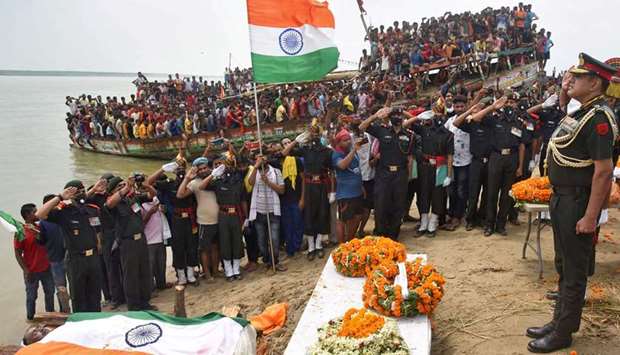
An officer pays tribute to Sunil Kumar, a soldier who was martyred in a border clash with Chinese troops in Ladakh region, during the funeral service in Maner, Bihar.