


The Education City Stadium is another gem that has risen from the desert as Qatar’s march towards the 2022 FIFA World Cup continues apace.
Bordered by the lushness of the Education City Golf Club, another magnificent sporting facility that officially opened earlier this year, and with a facade featuring diamond-esque geometrical patterns that appear to change colour according to the sun’s movement, the stadium has been aptly dubbed the Diamond in the Desert and will be considered a symbol of innovation and sustainability for years to come.
After the Khalifa International Stadium and Al Janoub Stadium, this is the third World Cup venue that has become fully match-ready and will host key games of the QNB Stars League next month when the tournament resumes after the coronavirus enforced disruption.
With Qatar focusing extensively on legacy and sustainability, the Education City Stadium has many features that can be the envy of the sporting world.
Education City Stadium has a design that draws on the rich history of Islamic architecture, blending it with striking modernity.
Like diamonds, the stadium’s design represents quality, durability and resilience, and will become something to be treasured both for the memories it holds and its future value to the country and region.
It will be one of the most prominent environmentally sustainable stadiums in the world, in addition to its design that is inspired by Islamic architecture.
The stadium, located 12km from the heart of the Qatari capital Doha, will accommodate 40,000 spectators and will be located in the western part of the Education City’s southern campus.
The Supreme Committee’s Project Manager of the stadium, Eid al-Qahtani, said earlier that the design of the stadium, with the flood lights on, will make it sparkle at night, as if a jewel in the desert, hence the nickname.
He said that the stadium’s most important characteristic is its location at the heart of Education City.
He added that it will overlook key main roads, starting with the southern Khalifa area to the coastal town of Dukhan.
The project manager said the stadium will set an example for the use of intelligent building systems that conserves the energy of things such as automatic lighting and air conditioning units.
The environmentally-friendly construction practices will also reduce the carbon footprint of the stadium, not just during the construction stage, but after its completion as well.
The design of the stadium was done using the best practices adopted globally, which will result in high levels of water and energy efficiency.
At least 20 percent of the materials used in building the stadium were from sustainable sources, in addition to purchasing 55 percent of the building materials from local sources.
The project was awarded the five-star Global Sustainability Assessment System programme (GSAS), thanks to the strategy employed in its design and construction.
It is the first stadium in the world to earn that recognition.
The arrival of World Cup spectators to the Stadium of Education City will be easy, whether through the Doha Metro in the presence of more than one station in the city of education, as well as the stadium stands beside the Dukhan highway.
The venue will have four parking lots that have a combined space for 16,000 cars, that’s in addition to the stadium’s parking, which fits 4,000 cars.
Fans will be able to reach the educational city stadium from the east side, but will not be allowed to access to the stadium by car, instead a train will take them to the gates.
The parking spaces will be allocated for organisers and officials of FIFA, as well as media and senior guests in accordance to the requirements of FIFA.
The presence of the stadium near both Al Rayyan Stadium and Khalifa International Stadiums confirms the compact nature of Qatar’s 2022 World Cup.
The stadium is only 4.5km away from the Khalifa International Stadium and six from Al Rayyan Stadium.
This will allow the public to move between the three stadiums and give them the opportunity to see three matches in a day, something that has not been achieved at any previous World Cup.
Al-Qahtani said that he believes that donating about 20,000 seats from the stadium, following the conclusion of the World Cup, to help build stadiums in developing countries in co-operation with FIFA will give the fans a great feeling.
Five key facts about Education City Stadium
Qatar’s ‘Diamond in the Desert’
The facade of the stadium features triangles that form complex, diamond-like geometrical patterns which appear to change colour with the sun’s movement across the sky. Like diamonds, the stadium’s design represents quality, durability and resilience – and will become something to be treasured, both for the memories it holds and its future value to the country.
Quarter-finals venue during Qatar 2022
During Qatar 2022, the stadium is set to host matches up to the quarter-finals stage. The stadium’s seating capacity during the tournament will be 40,000. After Qatar 2022, the capacity will be reduced to 20,000 following the removal of the modular upper tier. The excess seats will be donated to countries which lack sporting infrastructure – meaning the legacy of Qatar 2022 will be felt far and wide.
Set in the heart of Qatar’s education and research hub
Education City is the home of Qatar Foundation for Education, Science and Community Development (QF). Situated within Education City are leading universities, along with research and development institutions. As well as hosting matches during Qatar 2022, the stadium will provide sporting facilities for the entire QF community, including faculty and students. Parts of the stadium will be turned into classrooms and event spaces for QF schools and universities after the tournament.
The first Qatar 2022 venue to achieve a 5-star sustainability rating
The stadium achieved a 5-star rating under the Global Sustainability Assessment System for its design and build. Its range of sustainability features include direct access to public transport, low toxicity indoor materials and LED sports lighting. In addition, 85 percent of building materials were regionally sourced, while 29 percent were generated from recycled materials. The stadium also boasts carbon dioxide sensors for high occupant density spaces to ensure ventilation and indoor air quality, and a water efficient irrigation design to minimise landscape water consumption.
Doha Metro offers direct access for fans
Convenient access to the stadium is provided by the Doha Metro. Education City Station – on the Green Line – is located just 500m from the venue. A single ticket on the Doha Metro is QR3 ($0.82), while a day pass costs QR9 ($2.47).
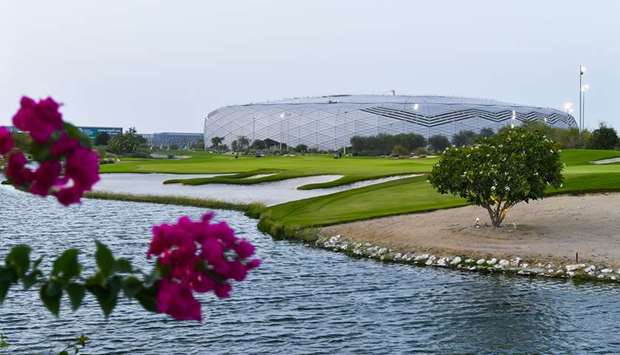
The Education City Stadium is bordered by the lushness of the Educaton City Golf Club. PICTURE: Noushad Thekkayil