


AFP/Dublin
Queen Elizabeth II yesterday visited the scene of a massacre by British forces during Ireland’s independence struggle on the second day of her groundbreaking state visit to the republic.

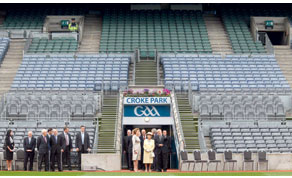
Queen Elizabeth enters Croke Park stadium with Ireland’s President Mary McAleese and Gaelic Athletic Association president Christy Cooney in Dublin yesterday
The British monarch heard of the tragic events in the two countries’ shared history and the hurt they inflicted, but was nonetheless told her visit to Dublin’s Croke Park stadium was an honour for her Irish hosts.
Such sentiments would have been unthinkable until recently as peace in Northern Ireland has created the conditions for the first visit of a British sovereign to the Republic since it won independence from London in 1922.
The “Bloody Sunday” of November 21, 1920, saw 14 people killed by British forces at Croke Park when they fired on a crowd of thousands of spectators at a Gaelic football game in response to the murder of 14 undercover British agents.
“We all know that in our shared history there have been many tragic events, which have inflicted hurt on us all,” Christy Cooney, the president of the Gaelic Athletic Association, told the Queen, who listened intently.
“While acknowledging the significance of the past, and honouring all those who lost their lives, including those that died in this place, the GAA has constantly supported and helped advance the peace process in Northern Ireland.”
The visit “will result in a further important underpinning and advancement of this process,” he said. “Your presence does honour to our association, to its special place in Irish life and to its hundreds of thousands of members.”
In a jovial moment, Cooney presented the Queen’s famously peppery husband Prince Philip with a hurling stick - then told him he could not use it inside. Joking about a British royal swinging a stick in Croke Park would once have been no laughing matter. But the joke provoked a humorous response - another small sign of just how far Anglo-Irish relations have come since the 1998 peace accords in British-ruled Northern Ireland.
Earlier yesterday in another highly-charged moment, Queen Elizabeth laid a wreath at the Irish National War Memorial Garden to honour the 49,400 Irish soldiers killed fighting for Britain in World War I.
Those who served in the 1914-1918 conflict were forgotten for decades due to deep unease over them serving in British uniform while Ireland’s independence struggle raged.
The soldiers were virtually ignored when they returned from the trenches of France and a national amnesia about the war developed after independence. They have only begun to be remembered and recognised in the republic in recent years.
The ceremony was also attended by Northern Ireland First Minister Peter Robinson, but his deputy Martin McGuinness, a republican whose Sinn Fein party opposes the Queen’s visit, declined to attend.
The 85-year-old Queen will rounded off the day by making the only speech of her four-day trip at Dublin Castle, the former seat of British power in Ireland.
British Prime Minister David Cameron said the visit was helping to “heal the wounds of the past” and showed the “very bright future between our two countries.” Yesterday’s itinerary began on a lighter note with a trip to the Guinness brewery, one of the country’s top tourist destinations.