


Five hundred railway coaches refitted to serve as hospitals, a rapid ramping-up of testing, and house-to-house surveys in the worst-affected areas were among measures announced yesterday to tackle a growing spike in Covid-19 cases in the Indian capital.
New Delhi has reported 2,000 new cases for the past two days and has emerged as one of the major centres of the pandemic in India along with the cities of Mumbai and Ahmedabad.
A total of 38,958 cases have been reported in the city and 1,271 deaths.
This could rise to at least half a million cases by mid-July given the steady spread of the virus, Delhi Deputy Chief Minister Manish Sisodia said.
Federal Home Minister Amit Shah held a meeting with Delhi Chief Minister Arvind Kejriwal and other top federal and state officials to address the growing crisis.
The meeting comes days after the Supreme Court pulled up authorities after media reports of people being turned away from hospitals and crematoriums and improper treatment of patients and bodies.
“The federal government will try to provide all essential equipment required by the Delhi government to fight this pandemic like oxygen cylinders, ventilators, pulse oximeters,” Shah tweeted after the meeting.
To meet the shortage of beds, the Railway Ministry will immediately provide 500 train coaches which are to be equipped with medical facilities to treat Covid-19 patients.
These would provide an additional 8,000 beds, Shah said.
Testing would be ramped up to three times the current rate within a week.
A comprehensive house-to-house health survey checking every person in the containment zones would also be carried out within a week, Shah tweeted.
Containment zones are areas where large numbers of Covid-19 cases have been reported.
Delhi has more than 240.
The Delhi government plans to turn banquet halls and hotels into temporary hospitals, in order to add 20,000 beds over the next few weeks, NDTV news channel reported, citing health department officials.
Shah said a committee was examining providing 60% of private hospital beds in Delhi at low cost for coronavirus patients, and fixing the cost of testing and treatment.
He added that a report would be submitted today.
That comes after a public outcry over the high cost of beds and coronavirus treatment at private hospitals.
Meanwhile Kejriwal said all small and medium multi-speciality nursing homes in the national capital have been converted into corona-special hospitals.
Under this scheme, 10 to 49-bed nursing homes are being made as ‘Covid-19 Nursing Homes’.
Kejriwal said the bed capacity for treating coronavirus patients in Delhi will be increased by 5,000.
“With this decision of the Delhi government, more than 5,000 beds will be available for coronavirus patients. In the next few days, our officials will talk to the owners of every nursing home and also solve their problems.”
The situation is also grim in Mumbai, where 1,383 new infections were reported yesterday, taking the city’s total to 56,740.
More than 20 members of the city’s police force have died of the virus.
The city’s authorities plan to provide 500 more intensive care units to hospitals, where 99% of available beds are currently occupied, the Hindustan Times newspaper reported, citing a Greater Mumbai Municipal Corporation official.
In Gurugram, Haryana, the administration has decided to build temporary quarantine centres in residential societies and upscale condominiums.
“We have asked Resident Welfare Associations to submit lists of common places like community centres, gyms, spa centres or clubs to develop as makeshift quarantine centres,” an official said.
Authorities in Gurugram believe that next one month is very crucial as chances of spreading Covid-19 are very high.
Efforts are underway to ensure all preventive measures are followed to avoid a Delhi or Mumbai like situation, the official added.
India imposed a national lockdown from March 25 but, faced with an economic crisis, gradually started to open up industry and transport in mid-May.
Offices, malls, hotels and restaurants started re-opening on June 8 along with temples and other places of worship, despite the recent steep rise in infections.
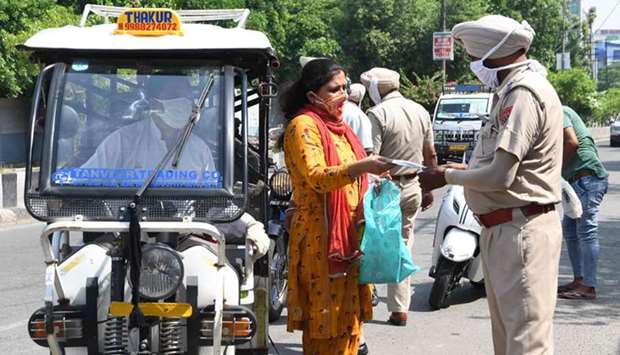
A policeman checks the travel pass of a commuter after strict lockdown norms for weekends and public holidays were imposed, in Amritsar, Punjab yesterday.