


The Bank of Korea should be prepared to gradually normalise the unprecedented steps it took since the coronavirus outbreak once the crisis subsides, and remain on alert over potential financial imbalances, governor Lee Ju-yeol said.
In a speech on Friday commemorating the 70th anniversary of the BoK, Lee reiterated his commitment to maintaining accommodative policy until the economy recovers, but also raised a topic that global policy makers may have to grapple with in a post-pandemic economy – asset bubbles driven by liquidity and low rates.
“While managing monetary policy accommodatively to overcome the crisis, we should not let our guard down against the potential accumulation of financial imbalances over the mid-to-long term,” Lee said in the text of a speech released by the bank ahead of a 10am video address.
Lee said there have been repeated cases in the past where excessive expansion of credit or asset bubbles have led to crises.
Since the outbreak, the BoK has slashed its key rate to a record low 0.5% and taken a series of steps to ensure sufficient liquidity is provided to firms and the market, including offering unlimited liquidity via repurchase agreements.
While Korea’s real economy is still in a slump, markets are showing signs of revival. Despite Friday’s global slide in stocks, South Korea’s Kospi index has almost recouped its pandemic-driven losses.
On Thursday, the government warned against housing prices rising in some parts of the country, pledging action as needed. “Many obstacles are expected until the crisis triggered in the real economy by Covid-19 is overcome,” Lee said.
The BoK “should overcome this crisis swiftly through pre-emptive steps, but also prepare ways to gradually normalise its unprecedented measures once the crisis calms,” he said.
Lee’s comments contrast with the Federal Reserve projecting its rates to remain near zero through 2022 and raises questions about whether the BoK could get ahead of the Fed in tightening policy, according to Kim Sang-hoon, an analyst at KB securities.
“Markets may wonder if this is the right timing to talk about normalising,” Kim said. “Lee may merely be stating a matter of principle.”
The won dropped as much as 1.1% against the dollar on Friday morning, its biggest decline in almost two months amid a global slide in equities on concern over new waves of virus infections.
South Korea’s 10-year bond future rose to 133.79 as of 9:47am in Seoul.
Lee added the central bank can use tools other than interest rates to stabilise markets and ensure a steady flow of credit, without offering specifics.
“Monetary policy needs to be managed accommodatively until our economy is expected to emerge from the coronavirus crisis and show recovery momentum,” he said.
In the past, Lee has used the annual speech as an opportunity to flag major policy changes.
His remarks last year that the central bank should respond appropriately to economic changes were seen as heralding a rate cut amid China-US trade tensions. The central bank lowered rates in July and again October.
The BoK expects the South Korean economy to contract 0.2% this year as exports slump and inflation slows.
Hundreds of thousands of jobs have been lost each month since March, while the country continues to see dozens of virus cases daily that prevent a swift rebound in economic activity.
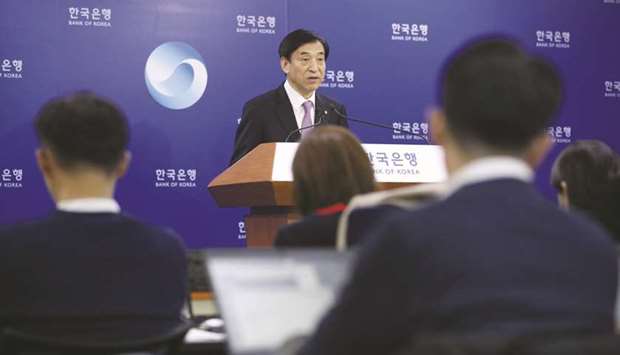
Lee Ju-yeol, governor of the Bank of Korea, speaks during a news conference in Seoul. In a speech on Friday commemorating the 70th anniversary of the BoK, Lee reiterated his commitment to maintaining accommodative policy until the economy recovers, but also raised a topic that global policy makers may have to grapple with in a post-pandemic economy u2013 asset bubbles driven by liquidity and low rates.