


Question: The recent white paper gives a full introduction of China’s actions in fighting Covid-19. Facing the largest public health crisis in 75 years, China is the first to contain its spread successfully. What is the key to China’s success against this unprecedented pandemic?
Answer: On June 7, the Chinese government issued the white paper: Fighting Covid-19: China in Action, which recorded the arduous work of the Chinese people in fighting the pandemic with detailed timelines, rich data charts and vivid stories. It shares the effective methods and experience of China’s effort in medical treatment and epidemic control, delivering confidence and strength for the international community to unite and co-operate.
Facing the sudden onslaught of a previously unknown virus, China has put the people’s interests first – nothing is more precious than people’s lives. The CPC and the Chinese government acted with a keen sense of responsibility and took multiple factors into consideration, made timely and resolute decisions, employed extraordinary measures to deal with an extraordinary emergency, and made every effort to safeguard people’s lives and health. The government decided that it would protect the lives and health of its people even at the cost of a short-term economic downturn and even a temporary shutdown. Guided by this principle, we took strict and comprehensive control measures, never tried before, in the city of Wuhan and Hubei Province. To stem the spread of the virus, the movement of people across the country was tightly restricted, gatherings were stopped, and the spring semester and business operations were postponed.
From an infant only 30 hours old to a centenarian, our goal was to save every single patient whatever the cost. As of May 31, China registered a cure rate of 94.3%. In Hubei Province, more than 3,000 patients over the age of 80, including 7 centenarians, have been cured, with many of them brought back to life from the verge of death. The medical expenditure for each patient is RMB23,000 on average (QR12,000), which were all covered by the government. For example, a 70-year-old patient was saved thanks to intensive treatment and care by more than 10 medical workers over a period of several weeks. The cost of his treatment, nearly RMB1.5mn (QR750,000), was fully covered by the government.
Q: What is China’s experience that could benefit Qatar and the rest of the world?
A: Since this unprecedented outbreak, China has been seeking effective ways for control and treatment through practice, and perfecting our methods through experience, gradually forming a “Chinese prescription.” We are very glad to share with our Qatari friends and people in the region.
First is centralised command and universal involvement. Covid-19 epidemic is a major public health emergency. President Xi Jinping sees it as the top priority, and has taken personal command, planned the response, overseen the general situation and acted decisively, pointing the way forward in the fight against the epidemic. Under the strong leadership of the CPC Central Committee with Xi Jinping as its core, China has put in place an efficient system under which the central authorities exercise overall command, while local authorities and all sectors follow the leadership and instructions of the central authorities, perform their respective duties, and co-operate with each other. This highly efficient system has made it possible for China to win its all-out people’s war against the virus.
We have built a tight prevention and control system involving all sectors of society. The Chinese government defined a set of requirements: early detection, reporting, quarantine and treatment with a focus on the four categories of vulnerable people (confirmed cases, suspected cases, febrile patients who might be carriers, and close contacts). As of May 31, a total of more than 740,000 close contacts had been traced and handled as appropriate. The 1.4bn Chinese people, irrespective of their gender, age, and occupation, have plunged themselves into the battle against the epidemic. With great faith in the Party and the government, everyone held the consensus that protecting oneself was protecting others and making contribution to the country, voluntarily followed guidelines of prevention measures, and took concerted actions against the virus. These actions demonstrated a core value of Chinese culture – the profound love of for family and the country.
Second is to cure patients and save lives at all costs. From the outset, China’s goal in its medical response to Covid-19 has been to improve the patient admission and cure rates and reduce the infection and fatality rates. Both traditional Chinese medicine and Western medicine were applied. A condition-specific and category-based approach was applied to medical treatment of patients. The infected were treated in dedicated medical facilities where medical specialists from all over the country and all the necessary medical resources were concentrated. Two hospitals with 1,000-plus beds each – Huoshenshan and Leishenshan – were built as specialist hospitals for treating infectious diseases, and a number of designated and general hospitals were expanded or remodelled.
Meanwhile, severe cases were treated by the best doctors using the most advanced equipment, and critical supplies were pooled to save lives at all costs. It is through such efforts that the Covid-19 fatality rate in China has dropped sharply. Early medical intervention has made it possible to have patients with mild symptoms cured without delay, thus significantly reducing the risk that their condition might worsen.
In Wuhan, the city government mobilised resources to repurpose stadiums and exhibition centres into 16 temporary treatment centres (cabin hospitals). With some 14,000 beds, these centres were able to admit all confirmed mild cases for treatment. This helped to reduce infections and virus transmission in communities and prevent mild cases from worsening. This is a major innovation in mass scale respiratory disease control. The 16 centres received a total of more than 12,000 patients; 8,000 and more were cured and discharged.
Chinese medicine (TCM) has played its part in the entire process of Covid-19 response, from early intervention to administering case-specific treatment. Chinese herbal formulas and drugs were administered to 92% of all confirmed cases. In Hubei Province, more than 90% of confirmed cases received TCM treatment that proved effective.
Third, science and technology underpin China’s efforts. Confronted by Covid-19, a previously unknown virus, China has exploited the pioneering role of science and technology and fully applied the results of scientific and technical innovation in recent years. Top scientific research resources have gathered from around the nation to support virus control. Key progress has been made in scientific research. Following the principles of safety, effectiveness and availability, China has accelerated the R&D and application of medicines, vaccines, and new test kits to meet the urgent needs of frontline virus control. Scientific R&D has also been integrated with clinical treatment and epidemic control. We promptly developed nucleic acid test kits, and introduced a range of high-sensitivity, easy-to-use test equipment and reagents. Putting existing medicines to new use, China has searched for effective medicines and new therapies, and summarised clinical experience based on rigorous in vitro experiments and pathogenic research.
Big data and artificial intelligence have also been used in epidemic control. China has fully utilised new technologies in research and analysis to forecast the trend of Covid-19 developments. These tools have also been exhaustively applied in epidemiological investigations to find every infected person and track every close contact for quarantine. A database has been set up in accordance with the law to provide data services for virus risk control, precisely identify different groups at risk, predict risk factors in different areas, and facilitate the orderly flow of people and the resumption of business operations. Via online platforms based on 5G technology, epidemiological teams in remote mountainous areas have been able to engage in real-time discussion with top experts thousands of miles away.
Q: The outbreak caused a severe impact on the global economy. Some countries began to lift lockdowns to ease the downward pressure on the economy, making some people worry about a second wave. How does China balance epidemic prevention and resumption of production?
A: The economy is a dynamic circulatory system, which cannot be shut down for a long time. On the premise of ensuring epidemic prevention and control, the resumption of production will provide strong material guarantees for epidemic control, and contribute to people’s livelihood, social stability, as well as to the world economy.
While lifting no guard on prevention and control, the resumption of production is gradually taking place in an orderly manner. The Chinese government has adopted a host of policies to reduce the burdens of businesses, particularly small and medium enterprises and self-employed people. These include measures such as reducing fees and lowering taxes, increasing government subsidies, strengthening financial support, stabilising and expanding employment, and improving government services. Preferential tax treatments such as exemption from VAT are offered to businesses in transport, catering, hospitality, tourism, sport, entertainment and other sectors hit hard by the epidemic. State-owned enterprises have taken the lead in resuming operations, providing impetus for upstream and downstream industries, including SMEs.
By the end of April, 99% of companies of designated size (with an annual revenue of more than RMB20mn) had resumed operations, as had 88.4% of SMEs and micro enterprises. Construction of over 95% of major projects across the country had resumed. In Hubei Province, more than 98.2% of enterprises of designated size had resumed operations, and 92.1% of their employees had returned to their jobs, and both these figures were close to the national average. Now, work on some key national science and technology projects, major national projects related to people’s daily lives, and landmark foreign-funded projects has resumed. The Chinese economy is accelerating its return to normal operation, and it is becoming increasingly robust.
Q: China’s ongoing efforts in providing support and assistance to other countries draw the world’s attention. What has China done to fight the epidemic through international co-operation? How will these efforts continue in the next stage?
A: At the time when the situation in China was at its most difficult, the international community provided valuable support and assistance to our country and our people. The Chinese nation never forgets the help and generosity it receives, and always reciprocates with the same goodwill. We are now doing all we can to support the international community in the fight against the coronavirus. Holding the principle of building a community of shared future for mankind, China has been carrying out exchanges and co-operating with the international community from the outset, contributing China’s wisdom and strength to the world.
President Xi has personally promoted international co-operation. He held phone calls or meetings with nearly 50 foreign leaders and heads of international organisations, attended the G20 Extraordinary Leaders’ Summit on Covid-19, and addressed the opening of 73rd World Health Assembly, calling for a joint effort all countries to overcome the virus and build a global community of health for all. China has made the utmost efforts to provide humanitarian assistance to the rest of the world. As of May 31, China had sent 29 medical expert teams to 27 countries, and offered assistance to 150 countries and 4 international organisations.
We have provided two batches of cash support totalling $50mn to the WHO, actively participated in and acted upon the Debt Service Suspension Initiative of the G20, and announced the suspension of debt repayments from 77 developing countries. From March 1 to May 31, China exported protective materials to 200 countries and regions, among which there were more than 70.6bn masks, 340mn protective suits, 115mn pairs of goggles, 96,700 ventilators, 225mn test kits, and 40.29mn infrared thermometers.
We have conducted more than 70 exchanges with countries and international organisations, and worked out diagnosis, treatment, prevention and control solutions, had them translated into three languages, and shared them with over 180 countries and more than 10 international and regional organisations. We have held 180 video conferences between experts, and also an international briefing together with the WHO on China’s experience in Covid-19 control.
Mankind is a community of shared destiny, and solidarity is our most powerful weapon to defeat the pandemic. At the opening of the 73rd World Health Assembly, President Xi Jinping put forward 6 proposals and 5 measures, including a $2bn of international aid over two years, the establishment of a global humanitarian response depot and hub in China in co-operation with UN, a co-operation mechanism for Chinese hospitals to pair up with 30 African hospitals, and promised to provide Covid-19 vaccine as a global public product.
China will continue to contribute to global effort against the pandemic. Currently, we are developing vaccines in five categories, which will be offered to the world as safe, effective and high-quality global public products once developed and deployed, and contribute to the accessibility and affordability of vaccines in developing countries. We are now in discussion with the United Nations to set up global humanitarian response depot and hub in China.
We will also play our part in stabilising the world economy. While continuing epidemic control, China is ready to join forces with other countries to address the deepening global recession, stepping up international co-ordination on macroeconomic policies, and jointly safeguarding the stable, secure and smooth operation of international industrial and supply chains. We will continue to supply the international market with anti-epidemic materials, pharmaceutical ingredients, daily necessities, and other supplies. At the same time, we will also advance reform and opening up, expand imports and outbound investment, and thereby contribute further to other countries’ fight against the virus and to a stable world economy.
China will continue assisting countries and regions with weaker health systems, including developing countries with in Asia, Africa and Latin America – especially Africa – to improve their capacity and performance in epidemic prevention and control. China plays a bigger role in assisting African friends, and to provide more material, technological and personnel support to their developing counterparts, especially those in Africa. We will offer more assistance to African countries, and offer all necessary support. We will continue to send the most urgent medical supplies, co-operate on medical technologies, and send more medical expert teams and task forces. China will also provide support to the Covid-19 Global Humanitarian Response Plan of the UN.
Q: Over the recent period, the United States has been accusing China of hiding epidemic information and delaying the release of genetic data. What do you think of their criticism?
A: I do not agree with these remarks, because they went seriously against facts. The Chinese government has never concealed or delayed anything. We have been sharing information and experience with the international community in a transparent and responsible manner. We wasted no time in reporting the epidemic situation to the WHO and the all relevant countries, releasing the information of coronavirus genome sequence, keeping the international community informed with regular updates, and advancing international efforts in prevention and control. Our massive efforts have made great contributions to the global fight against Covid-19, which can and will stand the test of history and time.
Q: How is China-Qatar co-operation in fighting against the pandemic, and what will be done in the future?
A: Facing this unprecedented public health disaster, the co-operation and friendship between China and Qatar have become an example of international health co-operation. We will never forget that it is Qatar which lent us a hand when we were at the most difficult times. His Highness the Amir Sheikh Tamim bin Hamad al-Thani held a telephone call with President Xi Jinping, expressing his firm stance that Qatar will firmly stand with China and is ready to provide help whenever China needs it. These words brought us great warmth in the face of difficulties. Qatar Airways opened its global network free of charge, sending flights fully loaded with medical supplies to China.
As the pandemic hit Qatar, the Chinese people feel for and will stand together with the Qatari people, and will join hands together to overcome difficulties. We will continue to step up information sharing, providing our latest experience in prevention and control, as well as diagnosis and treatment. Dr Zhong Nanshan, member of the Chinese Academy of Engineering and the top expert of Chinese medical team in combating Covid-19, will be invited to hold a video conference with the Ministry of Public Health, for in-depth exchanges on diagnosis and treatment with Qatari experts. We hope our Chinese solutions and wisdom will be of help to our Qatari partners.
China will continue to provide fast channels for Qatar to purchase and import of medical supplies from China, especially the raw materials that could help Qatar to improve production capacity of medical supplies such as masks and other medical supplies.
We will continue to work with Qatar in joint prevention and control, to share timely information and promote co-operation in the field of health, quarantine, transportation, immigration, making health co-operation a new highlight in our bilateral ties.
China will join Qatar to support global research on vaccines. Recently His Highness the Amir announced Qatar’s pledge of $20mn contribution to support Global Alliance for Vaccines and Immunisation. China is also stepping up to advance vaccine research and clinical tests, and is ready to provide the vaccine as a global public product once it is developed and deployed. China and Qatar could seek further co-operation in this regard.
China will join Qatar to provide assistance to developing countries around the world. Qatar has donated $140mn to international medical platforms, provided medical supplies to more than 20 countries, offered great support in building temporary medical facilities and improving the health system of LDCs, and assisted countries to take citizens back home. China highly appreciates active involvement and its spirit of humanity. We wish to strengthen co-operation with Qatar to help African and Arab countries’ public health systems and build a line of defence against the pandemic.
Sun rises after thunderstorms. After the pandemic, our friendship with Qatar will be more solid, the friendship between our two peoples will be closer, and the prospect of our bilateral relations will be even broader. We believe that under the guidance of President Xi Jinping and His Highness the Amir, China and Qatar will work more closely and eventually defeat the virus together, our joint work will build a community of shared future for health security between China and Qatar.
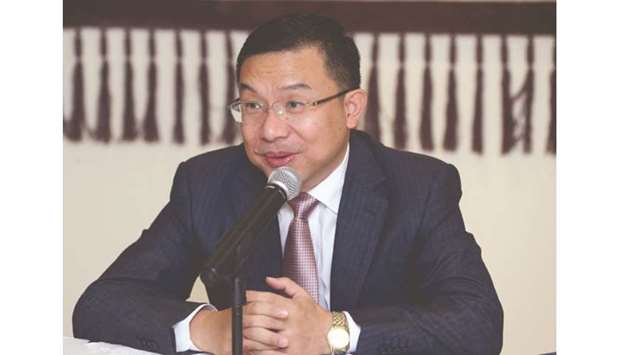
Chinese ambassador Zhou Jian.