


The Bank of England looks set to give itself at least another £100bn ($127bn) in bond-buying firepower next week to try to stop the coronavirus crisis from inflicting further damage on Britain’s economy.
The BoE slashed interest rates to an all-time low of 0.1% in March as the country went into lockdown, but it says it needs time to weigh up the risks of going below zero like some other central banks.
That leaves bond-buying as its main weapon for tackling what could be Britain’s deepest recession in three centuries.
The BoE is amassing gilts faster than the government is selling them in order to prevent the debt flood from pushing up borrowing costs.
It has already used up most of a record £200bn expansion of its asset purchase programme made in March.
Most economists say the Monetary Policy Committee will announce another £100bn boost on June 18.
That would be enough for the BoE to keep buying bonds at its current pace until August, when the MPC is next due to meet.
By then there should be a few more signals of how much long-term damage has been done to the world’s fifth-biggest economy.
Data tomorrow is expected to show Britain’s gross domestic product plunged by about 20% in April although there have been some signs of a recent bottoming out of the slump.
Cathal Kennedy, an economist with RBC Capital Markets, expects a £200bn increase, in line with the BoE’s tendency to buy more bonds than the government plans to sell.
Such a move could revive claims that the BoE has given up its independence to finance the government’s huge spending increases, a claim that Governor Andrew Bailey and other top officials deny.
Analysts at NatWest Markets said they expected the BoE would slow the pace of its bond-buying, meaning the next increase in the programme might not happen until November.
Samuel Tombs, of Pantheon Macroeconomics, said the BoE was unlikely to follow the US Federal Reserve and the European Central Bank and make longer-term bond-buying commitments.
Uncertainty about whether Britain will end its post-Brexit transition agreement with a new European Union trade deal at the end of 2020 made this too much of a risk for the BoE.
“It does not know whether the combination of the supply side shock from no EU trade deal being signed and the likely depreciation of sterling would have a bigger influence on inflation than the hit to demand,” Tombs said.
“Accordingly, we expect the MPC to stick to rolling QE extensions.”
Meanwhile, Bailey said he could see some early signs of an economic recovery in Britain as the government’s coronavirus lockdown restrictions are lifted, but warned there was still likely to be long-term damage.
“If there is any such thing as a normal recession... this one will be different. There will be elements of a faster recovery, because the first stage of the recovery is literally lifting restrictions and allowing people to go out,” he said.
“And we see evidence of elements of that recovery starting,” he added at a panel discussion hosted by the World Economic Forum yesterday. He did not give details of that evidence, but surveys of businesses and consumers in May and early June have pointed to some recovery as the lockdown lifts.
Bailey said the BoE expected the recovery to take longer than the simple lifting of restriction would suggest, however, as consumers were likely to be cautious about returning to restaurants and similar venues.
Long-term damage was also likely, as some businesses would not survive the coronavirus shutdown, even with government help, while others might find their business models — such as high-street stores or packed bars — no longer appealed to the public.
“We don’t know how much scarring there will be. I think it is reasonable to say there will be some but it is very hard to judge,” he said.
Bailey did not discuss monetary policy ahead of a BoE decision next week, when many economists expect it to add to the £200bn ($255 bn) of extra asset purchases it announced in March.
But he noted that the coronavirus pandemic gave more urgency to concerns the BoE had before the crisis that some businesses and non-bank financial institutions were ill-prepared for economic shocks.
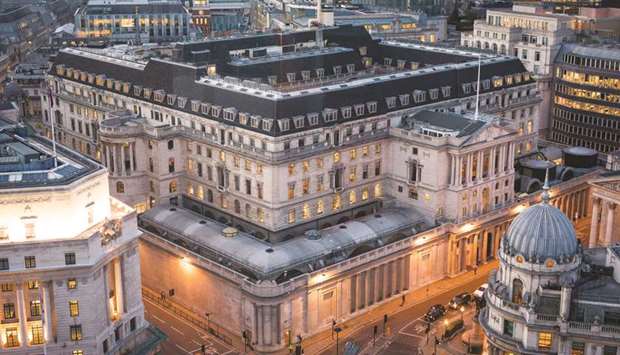
A view of the Bank of England building in London. The BoE is amassing gilts faster than the government is selling them in order to prevent the debt flood from pushing up borrowing costs.