


Downing Street has played down the likelihood of an imminent system of “air bridges” to allow overseas holidays this summer, as travel firms said the 14-day quarantine system which began yesterday could devastate their industry.
The first overseas passengers to be subject to quarantine arrived in the UK yesterday.
They have to give border staff an address where they will remain for two weeks, subject to fines of up to £1,000.
“All of the indications so far is that there has been a good level of compliance and we do expect the vast majority of people to play their part of helping to stop the spread of this disease,” Boris Johnson’s spokesman said.
Despite reports yesterday suggesting the government hoped to strike a cross-EU deal for mutual travel without quarantine via air bridges by the end of the month, No 10 said there was no update on this.
“We have talked about the possibility of air bridges. And that is something that we are continuing to work on. But nothing at all beyond that,” Johnson’s spokesman said.
The idea of a pan-EU plan is being played down by Downing Street, given that individual member states are tending so far to set their own quarantine rules.
Aviation and travel firms have said that without any air bridge plans the quarantine rules, which are due to be reviewed in three weeks, could spell the end for the summer holiday season this year.
Michael O’Leary, the chief executive of Ryanair, said that while some Britons were booking outward flights, there had been a collapse of bookings into the UK by overseas visitors, which would be disastrous for the domestic tourism market.
“What’s irrational about it is all of those countries have a much lower Covid rate than the UK,” he told ITV’s Good Morning Britain.
“Millions of jobs are going to be lost in British tourism because British hotels, British guest houses, British visitor attractions – all over London, the Globe, the London Eye, Madame Tussauds– will be empty, because the hundreds of thousands of Italians and Spanish and French people you get coming to Britain every July and August simply won’t travel.”
Mark Tanzer, the chief executive of Abta, the trade organisation for the travel sector, called for more transparency from the government.
“We must restart international travel as soon as it is safe to do so, and businesses and customers would benefit from the government outlining when this is likely to happen,” he said.
“There are many livelihoods at stake, and bookings will only start to pick up in earnest when people and businesses have a better idea as to what the government’s plan is to open up the UK and access to international destinations.”
Ryanair, along with easyJet and IAG, the owner of British Airways, have started legal proceedings in relation to the policy.
The No 10 spokesman declined to comment on the legal action, but said the government was confident in the rationale for the quarantine.
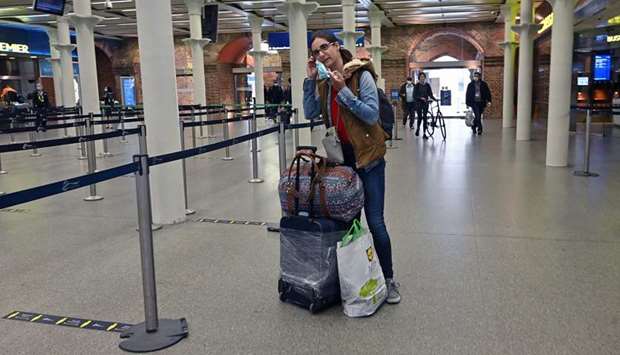
A passengers puts on a face mask as a precautionary measure against Covid-19, after arriving at St Pancras International station in central London, yesterday as the government’s planned 14-day quarantine for international arrivals to limit the spread of the novel coronavirus begins.