


Metro Manila began a gradual reopening even as parts of it were hesitant to lift the lockdown, and parts of Cebu extended the enhanced community quarantine because cases there remained high.
Besides Metro Manila, the other areas that transitioned from an enhanced community quarantine (ECQ) to a modified version of it included the provinces of Laguna, Bataan, Bulacan, Nueva Ecija, Zambales and Pampanga as well as its capital, Angeles City. The modified ECQ in those areas will remain in place until May 31, 2020.
Navotas, one of 17 cities in Metro Manila, actually appealed to remain under hard lockdown as the number of coronavirus disease 2019 (Covid-19) cases there remained high. Governors in several provinces near Metro Manila had similar concerns.
But all those local officials later accepted the move to gradually reopen under a modified ECQ.
Under a modified ECQ, local governments can allow the limited resumption of public transportation, certain industries to operate at half capacity and persons to leave their houses for essential goods and work.
Meanwhile, a hard lockdown will remain in Cebu and Mandaue cities until the end of May because of concerns about the high number of cases there. This move was in accordance with Resolution 37 of the Inter-Agency Task Force for the Management of Emerging Infectious Diseases (IATF-EID), which approved the continuance in those Visayan cities on Friday.
Most other parts of the Philippines saw even more restrictions lifted as they were placed under a modified general community quarantine (MGCQ) from Saturday.
In those areas, almost all industries, except those in amusement, were allowed to operate up to 75% capacity. And mass gatherings remain prohibited.
In an MGCQ, all individuals residing in these areas can go outside their homes, according to the IATF-EID guidelines.
Individuals and group outdoor exercises, including non-contact sports like golf, tennis, table tennis and swimming, will be allowed, provided that minimum public health standards are strictly enforced, the new guideline added.
Dine-in service in supermarkets, grocery stores and food preparation stalls will also be allowed, provided that the seating capacity does not exceed 50%.
Residential or face-to-face classes may resume in higher education institutions, provided that there is strict compliance with minimum health standards, consultation with local government units, and compliance with guidelines set by Commission on Higher Education.
Work in all public and private offices will also be allowed to resume physical work in “full capacity,” with alternative arrangements for senior citizens, individuals with health risks and pregnant women.
Work in government offices may be at full operational capacity or under alternative work arrangements, as agencies may deem appropriate, following the rules and regulations set by the Civil Service Commission.
Accredited diplomatic missions and international organisations may also resume full operations. Road, rail, maritime and aviation sectors of public transportation in areas under a modified GCQ are allowed to operate.
Passengers must strictly be seated with one-meter distance, and appropriate engineering controls must be in place.
The IATF-EID also authorised the use of private company shuttles, personal vehicles, bikes, and non-motorised vehicles in areas under an MGCQ.
Also, some gatherings will be allowed under an MGCQ.
Allowable activities are movie screenings, concerts, sporting events, entertainment activities, community assemblies, religious gatherings, and non-essential work gatherings — so long as the seating capacity at the venue is also limited to 50%.
Contrary to an earlier pronouncement that a GCQ will be part of the “new normal,” the IATF-EID felt comfortable enough to lift more restrictions than it had earlier anticipated to allow for a rebooting of the economy.
Meanwhile in Navotas, Mayor Tobias Tiangco lifted the extreme ECQ in his city after the IATF-EID denied his request to retain the ECQ because of the increasing number of Covid-19 cases. Like elsewhere in Metro Manila, Navotas shifted to MECQ, despite Tiangco’s reluctance.
“I have no choice even if according to data, cases are increasing and even according to Department of Health (DOH), Covid-19 cases in Navotas are accelerating,” he told Manila Times.
“We need to take drastic measures to help flatten the curve of Covid-19 cases, but as I had said I have no choice but abide by the IATF decision for the city to shift to MECQ,” Tiangco said.
Despite his concerns, he has permitted tricycles and pedicabs to operate, but their operators were told to strictly follow health and safety precautions, including limiting every trip to just one passenger.
“We will also give way for the continuation of government infrastructure projects especially on flood control and school building,” the mayor added.
Tiangco said the curfew and three-day limit for going to the market would be retained, but the liquor ban has been lifted.
The city will continue to limit residents from going outside.
Only one resident per household, whose name is printed in the home quarantine pass, will be allowed to go out of their homes. And when they do so, they must wear face masks and observe physical distancing by avoiding large groups and crowds.
Essential workers who are exempted by the IATF-EID, including those who work at the Philippine Fisheries Development Authority, are allowed to go to work. But they should have a valid company ID and essential work pass issued by the barangay or village.
In Quezon City, Mayor Josefina Belmonte issued a memorandum prescribing localised guidelines for an MGCQ.
The city government will continue implementing the Special Concern Lockdown Areas, where select places with high Covid-19 cases or high probability of virus spreading will be placed under strict containment, Belmonte said in a statement. The city would require businesses with 10 or more employees to submit to the City Health Department their program for employee testing, at cost to the establishments.
Public transportation would not be allowed in the city, the mayor said.
She permitted those “operational” establishments under an MECQ to provide point-to-point private transport services or shuttles, including the hiring of public utility buses, public utility jeepneys or high occupancy vehicles, for the “exclusive use” of their employees.
Belmonte also allowed tricycles to operate under strict health and safety conditions and adherence to the route indicated in their franchise.
The mayor encouraged all drivers concerned to submit themselves for Covid-19 checking in one of the city’s community-based centres.
The city government plans to expand its current “Libreng Sakay” (Free Rides) bus services to accommodate residents travelling to and from permitted establishments.
Belmonte urged every barangay to provide free parking spaces for residents who use bicycles while public transportation remained restricted.
All establishments in Quezon City were asked to assign a Health and Safety Officer accountable to ensure that these guidelines are strictly implemented.
Businesses like manufacturers of food, water and non-alcoholic beverage, and medical and hygiene products; hospitals and clinics; and essential retailers could now fully operate under the MECQ.
They were also allowed to operate with up to 50% of their workforce on-site, including general manufacturing, office administration and support services.
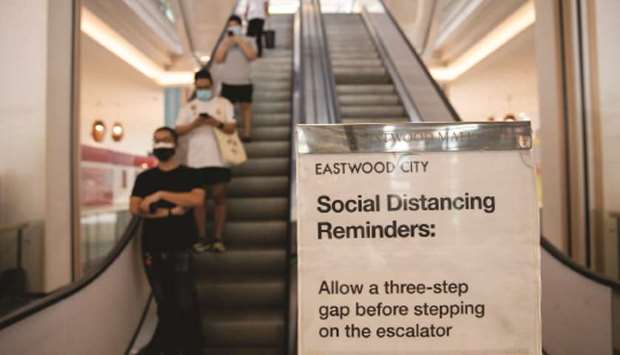
A poster reminding shoppers to maintain social distance to prevent the spread of the coronavirus disease (Covid-19) is placed beside an escalator in a shopping mall in Quezon City, Metro Manila, yesterday.