


The Bank of Japan’s buying of local exchange-traded funds may be cooling as fast as it heated up, in another possible sign of stabilising markets.
The central bank’s ETF purchases during the first 12 days of May totalled 126.5bn yen ($1.2bn), compared with 490.4bn yen during the same period in April. Granted, that’s comparing eight trading days in April against just five in May due to Golden Week holidays, but the BoJ hasn’t bought anything more than a token daily amount since May 1. And the pace has markedly slowed since March, when it made daily record purchases of 201.6bn yen four times. The BoJ’s buying of Japanese real estate investment trusts has also come back down, falling to a total of 3.5bn yen in the first 12 days of May versus 12bn yen in April.
“There’s a chance the BoJ will temporarily cut back on its purchases” given that the Nikkei 225 Stock has climbed back above the psychologically important 20,000 level, said Shingo Ide, chief equity strategist at NLI Research Institute.
The deceleration in BoJ purchases follows a rebound in Japanese stocks, which have recovered about half of their losses attributable to the coronavirus outbreak. The Nikkei 225 entered a technical bull market in April after falling into a bear market in March.
In March, the BoJ doubled its annual target for ETF purchases to 12tn yen as it added to stimulus to combat the impact of Covid-19. But it also said it would “in principle” continue buying at the original 6tn yen pace.
The Tokyo Stock Exchange REIT Index fell as much as 3% on Wednesday, the most since April 21.
Shinichi Uchida, the BoJ’s executive director in charge of monetary policy and financial markets, said on Tuesday that the central bank intends to continue with ETF purchases as long as needed.
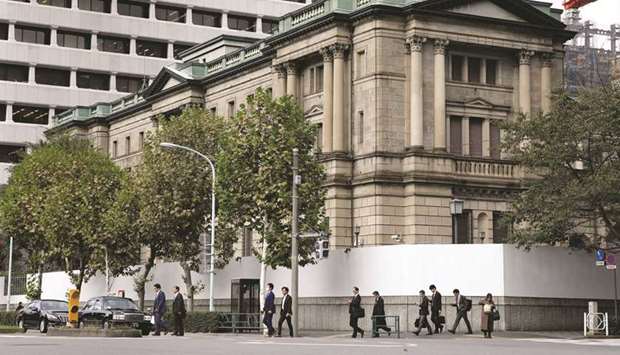
Pedestrians cross a road in front of the Bank of Japan headquarters in Tokyo. The central bank’s ETF purchases during the first 12 days of May totalled 126.5bn yen compared with 490.4bn yen during the same period in April.