


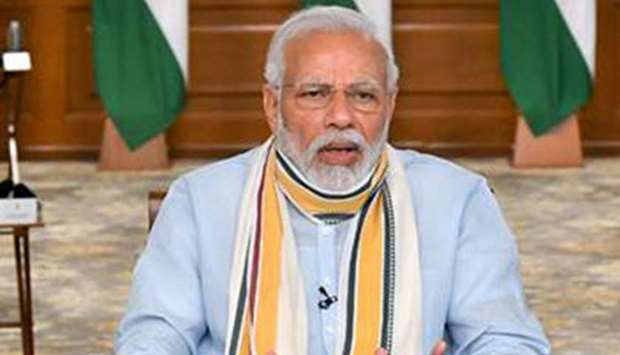
India has more than 70,000 cases among its 1.3bn population and is set to surpass China, the origin of the outbreak, within a week.
Modi said strict stay-at-home orders would be extended beyond May 17 with a new set of rules.
“It will be based on suggestions received from states,” he said.
In an address to the nation, the prime minister said the package was equivalent to 10% of India’s gross domestic product, and was aimed at the multitudes out of work and the businesses reeling under the prolonged shutdown.
In March, the government said it was providing around Rs1.7tn ($2.6bn) in direct cash transfers and food security measures, mainly for the poor, but was widely accused of doing too little.
Finance Minister Nirmala Sitharaman would unveil further details in the next few days, he added.
“The package will also focus on land, labour, liquidity and laws. It will cater to various sections including cottage industry, medium and small enterprises, labourers, middle class, industries, among others,” Modi said.
He said India must realise its potential as the lead player in the 21st century by focusing on its self-reliance.
“The condition of the world today teaches us there is only one way - that of building a self-reliant India,” he said.
“The coronavirus crisis has made us realise well the importance of local manufacturing, local market and local supply chain. In this crisis, this ‘local’ has met our demands, this ‘local’ has saved us. Time has taught us that ‘local’ will have to be made a mantra of our lives.”
He encouraged Indians to buy local products and also to promote them with pride.
Simultaneously, India would unveil “comprehensive” reforms to bring about simpler laws, a rational tax system and building a better infrastructure, strong financial system as well as attract investment.
Economists said the new package included the March allocation as well as liquidity measures announced by the central bank worth $6.5 tn rupees.
“Headline announcement looks positive. Would include around Rs6.5tn already done by RBI (Reserve Bank of India) and the first package. So - additional is Rs13.5tn,” said Sandip Sabharwal, a Mumbai-based fund manager.
“It doesn’t match the gross borrowing details of the government, so we need to look at details. Headline number should, however, excite the markets near-term.”
Last week, India increased its borrowing programme for the year to Rs12tn from 7.8tn to fund some of the expenses.
Even before the pandemic, India’s growth was slowing and public finances were strained because of poor tax collection and higher spending.
Last month, the ratings agency Fitch said India’s sovereign rating could come under pressure if its fiscal outlook deteriorates further as the government tries to tackle the coronavirus crisis.
Some commentators said it was too early to say how effective the package would prove to be.
“Very often, when the government has made these huge, very big announcements the figures have often been fudged,” Yogendra Yadav, founder of the opposition party Swaraj India, told a television channel.
“What we have right now is a statement of intent. How can you quarrel with intent?”
Modi said the reforms of the land and labour markets were intended to make India more competitive and a big player in global supply chains, some of which could shift away from China after the pandemic.
Business leaders say potential investors often choose Vietnam, Thailand or Bangladesh ahead of India because of the time required to buy land for factories, restrictive labour laws and higher borrowing costs.
“These reforms will promote business, attract investment, and further strengthen ‘Made in India’,” Modi said.
Governments and central banks around the world have unleashed unprecedented amounts of fiscal and monetary support for economies that are reeling from the pandemic.
“India’s response has so far been tepid compared to other key nations and thus the catch-up is welcome and is also the need of the hour,” said Madhavi Arora, lead economist at Edelweiss FX and Rates.
“It needs to be seen how much will be in the form of direct budgetary support to gauge the immediate fiscal hit and the consequent funding sources.”