


Lebanon will start negotiations with the International Monetary Fund (IMF) in the next two days, Finance Minister Ghazi Wazni said on Tuesday, as Beirut seeks aid to deal with its financial crisis.
Lebanon, which officially requested IMF assistance on May 1, is grappling with a crisis seen as the biggest threat to its stability since the 1975-90 civil war.
“There is contact with the IMF and in the coming two days we will start the negotiation sessions,” Wazni told reporters after a cabinet session.
Turning to the IMF is widely seen as the only way for Lebanon, one of the world’s most heavily indebted nations, to secure the financial assistance it urgently needs.
A source close to the government said the two sides held an introductory meeting on Monday ahead of Wednesday’s detailed talks.
Wednesday’s talks via video conference will include officials from the prime minister’s office, central bank and presidency.
Lebanon defaulted on its foreign currency debt in March, while its currency has lost more than half its value since October.
Savers have largely been shut out of foreign exchange deposits as the supply of dollars has grown scarce.
Wazni said last week that Lebanon hoped to secure IMF financial support of $9bn-$10bn.
A government economic recovery plan, which outlines steps that would result in vast losses for Lebanon’s financial system, will form the basis for the IMF talks.
Donors, which have supported Lebanon in the past, say the government must enact long-delayed reforms to address state waste and corruption, widely seen as root cause of the economic crisis, before they will consider any fresh aid. Lebanon’s government has ordered most of the country to shut down again for four days, starting on Wednesday night, as it seeks to ward off a coronavirus resurgence after easing some restrictions.
The country has been under lockdown since mid-March to rein in an outbreak that has infected 870 people and killed 26. Lebanon started lifting restrictions last week as part of a longer-term plan, letting restaurants, hair salons, construction sites and others re-open at lower capacity.
But the cabinet agreed on Tuesday on the “full closure” for four days to curb a rise in new infections in recent days, after a drop in cases which the government had hailed as a success.
“This achievement is at risk of collapsing” because some people did not comply with the guidelines, Prime Minister Hassan Diab was quoted as saying during the meeting.
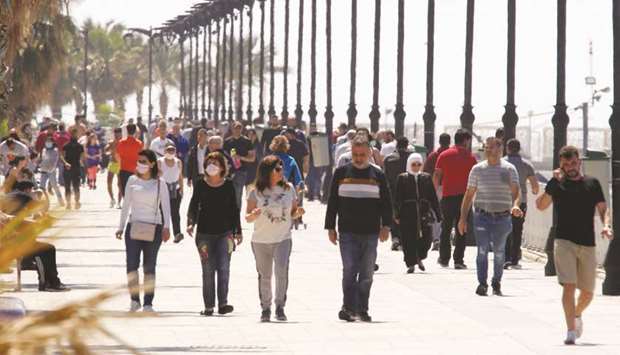
People walk along Beirut’s seaside Corniche, as Lebanese authorities warned of a new wave of the coronavirus disease in Beirut, on May 10. Lebanon defaulted on its foreign currency debt in March, while its currency has lost more than half its value since October. Savers have largely been shut out of foreign exchange deposits as the supply of dollars has grown scarce.