Reuters/London  

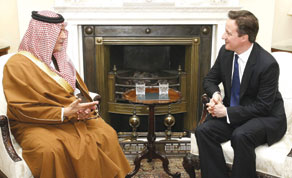
Prime Minister David Cameron talks to Saudi Arabia’s Foreign Minister Prince Saud al-Faisal at 10 Downing Street, in central London yesterday

Less than half of Britons support military action in Libya, fewer than initially supported the Iraq invasion in 2003, a poll yesterday showed.
The divisive Iraq war, in which 179 British soldiers died, still casts a shadow over attitudes to politics and war, and makes Prime Minister David Cameron’s job harder to win over a skeptical public, a pollster said. “One of the challenges facing Cameron, and other leaders, is so to lead military action in Libya that voters start once again to trust their leaders at such perilous times,” YouGov’s Peter Kellner said. A YouGov poll in the Sun, Britain’s most popular daily newspaper, repeated some questions asked in March 2003 when British troops joined the US in invading Iraq. Then, 53% supported the invasion, compared with 45% who think military action in Libya by Britain, France, the US and other countries is right. Eight years ago, 39% opposed the invasion of Iraq, compared with 35% who are against taking action in Libya. However there have been no mass anti-war demonstrations this time, perhaps because of the speed with which events have developed, whereas hundreds of thousands protested then. Cameron has the dual challenge of convincing a wary public that a potential standoff in Libya is a victory and of overcoming a decline in trust caused by Iraq, Kellner said. The Conservative leader has gone to great lengths to differentiate the Libyan campaign with that of Iraq, when former Labour Prime Minister Tony Blair took Britain to war with no specific UN mandate. Blair was also accused by his critics of deliberately misleading the public over the reason he gave for war -- Saddam Hussein’s illegal weapons of mass destruction, which were never found. Cameron managed to secure a UN resolution for a no-fly zone over Libya, which received the backing of the Arab League, and has vowed not to send in ground troops. But while looking to avoid the risks of Iraq, the resolution’s lack of a call for regime change may deprive him of the benefits of a clear victory. “They say the key thing is to protect the Libyan people from Gaddafi,” Kellner added. “I doubt that will be enough for most British voters. An extended standoff is unlikely to impress them.” More than 2,700 people were questioned between March 20 and 21, after the coalition began firing missiles at Libya. A ComRes-ITN poll on Monday found that 43% disagreed with the action in Libya and 22% were unsure.Meanwhile, Britain is talking to Arab nations in a bid to “develop” the military coalition arrayed against Libyan leader Muammar Gaddafi’s forces, a spokesman for Cameron said.Foreign Secretary William Hague briefed the cabinet on efforts to boost the coalition, which is led by the United States, France and Britain and includes some other Western states and Qatar, said the spokesman. Asked if there had been any progress on drawing in other Arab countries, he told reporters: “That’s something the foreign secretary referred to in cabinet. “He was talking about continued efforts to develop and maintain that coalition of countries, which was what the prime minister was talking about yesterday (in parliament). “And I think there is a lot of activity in the Foreign Office to ensure that happens.” The cabinet was “completely unified” behind the military action, he added. The coalition is acting under a UN Security Council resolution authorising all necessary means to stop Gaddafi’s forces harming civilians as they battle the rebellion against the Libyan leader’s four-decade rule. There is co-ordination but no unified command, and moves to hand control of the operation to Nato are dividing the alliance. France is warning that Nato control could scare off Arab countries while Turkey has ruled out any involvement.