


France’s exit from 54-and-a-half days of coronavirus lockdown got off to a bumpy start yesterday as media published images of severe early-morning crowding on Paris public transport.
Broadcaster BFMTV showed scenes of a packed carriage on the city’s metro line 13, which serves working class northern suburbs, after the first train of the day ran 40 minutes late.
Newspaper Le Monde meanwhile published photos of tightly-packed crowds trying to board a suburban train at the Gare du Nord station.
Services got back to normal quickly, and Transport Minister Jean-Baptiste Djebbari insisted that the situation was satisfactory overall.
However, the radical left and far-right opposition were quick to point the finger at the government, with left-wing lawmaker Eric Coquerel tweeting that “nothing has really been planned to transport workers from working-class towns”.
In the main moring rush hour, however, the Gare de l’Est railway station and several metro stations on the Left Bank were eerily quiet in the main.
With employers under instructions to keep staff working from home as much as possible, usually packed rush-hour metro trains passed through a Left Bank station with at most a few dozen passengers on board.
Signs outside the stations reminded passengers that masks are now obligatory on public transport and, at Place d’Italie station on the Left Bank, a couple of riot police kept an eye on incoming passengers.
Above ground, there were more cars and bikes on the streets than the previous week, but city buses had relatively few riders.
“It’s a normal day,” one passenger, who gave her name as Blandine, told DPA at Gare de l’Est. “You have to remain cautious, wear a mask and keep your distance, reduce your interactions with other people ... it’s not the end, it’s just another stage.”
President Emmanuel Macron reinforced that message with a tweet.
“SAVE LIVES: REMAIN CAUTIOUS” replaced his previous “pinned” message: “SAVE LIVES: STAY AT HOME.”
France has suffered one of Europe’s worst outbreaks of coronavirus, with 26,380 deaths as of Sunday.
Under the lockdown rules, people were allowed leave their homes only for a number of essential reasons and had to carry with them a signed declaration stating why they were out and when they were allowed to be so.
With authorities anxious to keep social mingling to a minimum for the moment, many restrictions remain.
Anyone who can work from home should still do so, the government says.
Cafes and restaurants remain closed for the moment.
Primary schools are to reopen gradually this week, with middle schools reopening the week after, though only in areas less affected by coronavirus.
Signed declarations are still required for anyone taking public transport at peak hours in the greater Paris region, with usage reserved for commuters and those on essential trips.
A new rule limiting journeys of more than 100km could not come into force yesterday, however, as the government was still awaiting a ruling on the constitutionality of an emergency law passed by lawmakers on Saturday.
Other measures, including the official end to lockdown rules and a new nationwide requirement to wear masks on public transport, were made law by a temporary decree signed by Prime Minister Edouard Philippe and other ministers and having effect only for two days.
In Paris and northeastern France, which are categorised as “red zones”, meaning that they have a higher rate of Covid-19 cases or hospitalisations, public parks remain closed.
Despite a continuing ban on cross-border travel except for essential purposes, an inter-city express service between France and Germany resumed yesterday.
The long-distance route from Frankfurt to Paris via Saarbruecken will operate again with an ICE train running in each direction daily, a spokesman for German national rail operator Deutsche Bahn said.
Travel restrictions also remain between mainland France, the Mediterranean island of Corsica, and overseas territories.
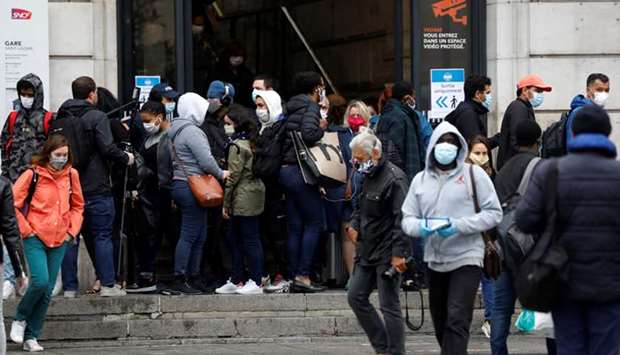
Commuters leave Paris’s crowded Saint-Lazare train station yesterday.