


Several Indian and Chinese soldiers were injured in a high-altitude cross-border clash involving fistfights and stone-throwing at a remote but strategically important mountain pass near Tibet, the Indian Army said yesterday.
There have been long-running border tensions between the nuclear-armed neighbours, with a bitter war fought over India’s northeastern-most state of Arunachal Pradesh in 1962.
“Aggressive behaviour by the two sides resulted in minor injuries to troops. It was stone-throwing and arguments that ended in a fistfight,” Indian Army Eastern Command spokesman Mandeep Hooda said.
The “stand-off” on Saturday at Naku La sector near the 15,000ft Nathu La crossing in the northeastern state of Sikkim - which borders Bhutan, Nepal and China - was later resolved after “dialogue and interaction” at a local level, Hooda said.
“Temporary and short duration face-offs between border-guarding troops do occur as boundaries are not resolved,” he added.
The violent clash is the first between the two countries since 2017, when there was a brawl between Chinese and Indian soldiers near the northwest region of Ladakh.
In the same year, there was a high-altitude standoff in Bhutan’s Doklam region after the Indian army sent troops to stop China from constructing a road there.
China still claims about 90,000sq km of territory under New Delhi’s control. The latest skirmish is yet another indicator of a bilateral relationship that has been in a tailspin for some time now.
Ever since the coronavirus pandemic, which originated in Wuhan city of China’s Hubei province, the relationship between the two countries has been under strain.
Though unlike the US administration, the Indian government did not blame China for the spread of Covid-19 infection, mainstream media and social media users in India have been critical of President Xi Jinping’s government.
Overlooking the public outrage in India, the government went ahead with ordering Covid-19 rapid testing kits from China.
However, after several complaints of fault in the kits, the government cancelled orders for about half a million kits, causing exasperation in Beijing.
The negative view against New Delhi worsened when the government last month changed the rules of Foreign Direct Investment (FDI). To check predatory business practices during the coronavirus-related lockdown in the country, the government put all FDI proposals from countries sharing border with India under the government approval route.
Ever since China has been outspoken about its displeasure with India.
Jayadev Ranade, a leading expert on China, said though the face-off between the two sides have occurred in the past, the latest skirmish is a result of deterioration in relations.
The face-off at Naku La sector is where China has been claiming that a dispute exists.
“Within a year of having agreed with the then prime minister Atal Bihari Vajpayee that Sikkim belongs to India and China will have no claim on it, a Chinese vice foreign minister told our then external affairs minister that the issue is not settled,” Ranade said.
China, he said, has been beefing up its forces and defence infrastructure in Tibet Autonomous Region (TAR).
“Around April 2, there were 300-500 People’s Liberation Army (PLA) vehicles around Tashigong opposite Demchok-Koyul, relaying the runway at Gargunsa airport,” he said.
Srikanth Kondapalli, a professor of Chinese studies at Jawaharal Nehru University in New Delhi, argued that the face-off in Sikkim, is in accordance with the direction received from the PLA.
“China’s apex foreign affairs work conferences of November 2014 and June 2018 ordered the foreign ministry and the embassies abroad to pursue the goals related to border with India, as listed in the PLA white papers of 2015 and 2019”.
The Naku incident, he said, is a follow-up to the directives which were also reflected in Doklam incident in 2017 or Pangong Tso incident in 2019 or Asaphila incident in Arunachal Pradesh.
“As the directives are from the top, we should expect more of such incidents in future and take remedial measures,” he warned.
Through aggressive actions amid a pandemic, China may be seeking to remind its neighbours that they could face further trouble by siding with the West in supporting an inquiry into the origins and spread of the coronavirus, security expert Brahma Chellany wrote in a series of tweets.
The forthcoming World Health Organisation assembly meeting will see a push for such an inquiry, he said.
The skirmish, Chellany said, comes after Chinese coast guard ships, for a second day in a row, intruded into the waters of Japanese-controlled Senkaku Islands.
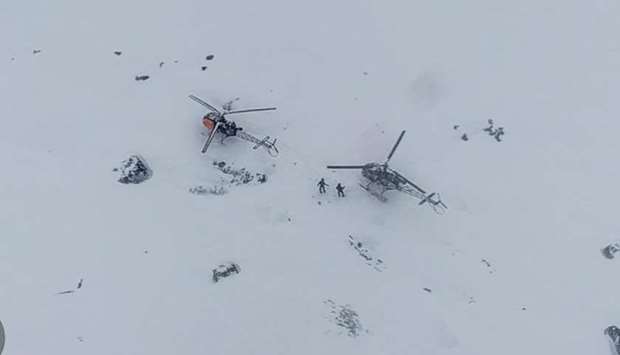
A handout photograph taken on May 8, and released by the Indian Army yesterday shows military helicopters landing to evacuate stranded IAF and Air Dispatch personnel from a high-altitude emergency landing site in Sikkim.