


More commuters should consider cycling or walking when Britain’s coronavirus lockdown is eased to take the pressure off public transport capacity that is likely to drop by 90% under social distancing requirements, Transport Minister Grant Shapps said yesterday.
He urged people to continue to work from home where possible, but said that those who did have to commute to work should consider cycling or walking rather than using their cars.
The requirement for buses, trains and underground rail services to maintain social distancing rules means they will only be able to carry vastly reduced passenger numbers.
However, an increase in private car use to commute to work is likely to lead to roads and motorways becoming choked with traffic.
“Even with public transport reverting to a full service, once you take into account the 2m social distancing rule, there would only be effective capacity for one in 10 passengers in many parts of our network, just a tenth of the old capacity,” said Shapps.
He noted that in some parts of Britain there had been a 70% rise in the number of people using bikes during the pandemic.
“Whilst it’s crucial that we stay at home, when the country does get back to work we need to ask those people to carry on walking and cycling and for them to be joined by many others as well,” he said.
Shapps said local councils will be required to reallocate road space for significantly-increased numbers of cyclists and pedestrians.
He said pop-up bike lanes with protected space for cycling, wider pavements, safer junctions, and cycle and bus-only corridors will be created within weeks, while e-scooter trials will be brought forward, with the potential for rental vehicles on UK roads as early as June.
Trials of the use of e-scooters on British roads are also due to be fast-tracked, according to the Press Association.
Currently e-scooters, which can travel at up to 15.5mph, are banned on roads and pavements in the UK.
The government launched a consultation about legalising e-scooters in March, but would need to pass secondary legislation to legalise their use.
The news comes as campaigners called for a fundamental redesign of the transport system to help prevent a bounce-back in air pollution levels once the lockdown ends.
Studies have shown that air pollution may play a role in higher Covid-19 mortality rates, with hearts and lungs weakened by dirty air.
The Covid-19 respiratory disease is caused by the coronavirus.
In Italy, coronavirus was detected in air pollution samples by scientists investigating if this could enable it to be carried over longer distances and increase the number of people infected, though it remains unknown if the virus remains viable on pollution particles.
Nine organisations – including Greenpeace and the Transport Action Network – have written an open letter to the secretaries of state for transport and the environment, as well as the chancellor, leaders of local and regional authorities, and city mayors.
“It would be completely absurd if, after the unprecedented efforts and sacrifices made to save thousands of lives from Covid-19, we allowed thousands more to be cut short by the devastating impacts of toxic pollution,” it reads.
The group’s demands include wider pavements, protected cycle tracks and the installation of bus gates, bollards and planters to limit traffic in residential and shopping streets.
It also calls for networks of low-traffic neighbourhoods and for walking and cycling to be prioritised along main roads.
Greenpeace UK, CPRE, Cycling UK, the Environmental Defence Fund, Global Action Plan, Living Streets, Possible, Transport Action Network, and Transport and Environment have signed the letter.
The campaigners also suggest introducing a 20mph speed limit in built-up areas and a ban on the sale of new petrol and diesel cars and vans by 2030.
Restrictions brought in to tackle the coronavirus pandemic have led to a huge drop in road traffic and a fall in air pollution of up to 60% in parts of the UK.
A YouGov poll commissioned by Greenpeace UK found 71% of people are concerned about the possibility of air pollution returning to pre-lockdown levels once restrictions are lifted.
It also found that 58% backed the introduction of cycle lanes on urban main roads along with increased government funding for walking and cycling infrastructure.
The letter calls for immediate action to lock in some of the reduction in road traffic and the introduction of new measures to ensure that “when the nation gets moving again, it does so in a cleaner, safer way”.
Milan and Brussels have already taken steps to prioritise walkers and cyclists in their city centres, according to Rebecca Newsom, Greenpeace UK’s head of politics.
“There are many things about the lockdown people will be glad to leave behind, but cleaner air is not one of them,” she said. “Yet there’s a real risk that congestion and toxic pollution will be back on our streets as soon as restrictions are lifted.”
Prime Minister Boris Johnson is expected to announce today the next phase of Britain’s battle to tackle the health crisis, following a review by ministers of lockdown measures that have all but shut the economy and kept tens of millions of people at home for nearly seven weeks.
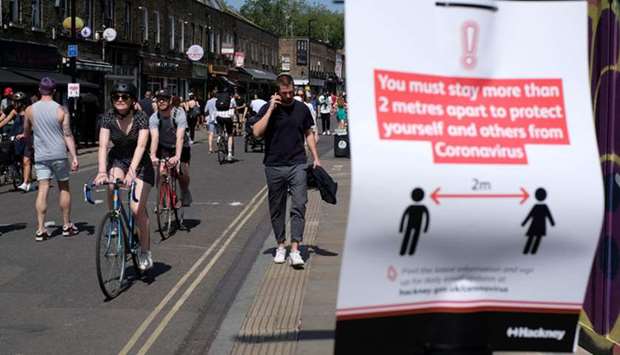
People walk and cycle along London’s Broadway Market, following the outbreak of the coronavirus disease.