


Villagers placed the bodies of three victims of a deadly gas leak from an LG Polymers plant in Andhra Pradesh at the gates of the site yesterday, and demanded the factory be shut down immediately and its top management arrested.
Toxic styrene gas spewed out of the plant near Visakhapatnam on Thursday, killing at least 11 people and forcing 800 more to be hospitalised for treatment.
Hundreds of victims remain in hospital.
Yesterday, villagers staged a sit-in at the plant’s gate with three bodies of victims as the Director General of Police Gautam Sawang visited the plant.
Some protesters barged into the compound and police had to block their way to allow officials investigating the leak to come in and out.
Protesters shouted “We want justice!” and demanded a permanent closure of the factory that is close to residential areas.
They also called for the arrest of factory management of LG Polymers, which is a subsidiary of LG Chem Ltd, South Korea’s biggest petrochemical company.
Relatives of the dead stood nearby, many in tears, while others relived the horror of the sudden accident.
“I saw people carrying their children on their shoulders looking for water. They could not move because of the gas, I thought they were dead,” said one man.
At least three children were among the dead.
Late Thursday, an evacuation zone around the plant was widened and hundreds more people were moved to safety after fears of a new leak.
Some have since been allowed to return.
The gas leaked out at around 3.30am on Thursday.
Horrifying footage on television showed men, women and children slumped motionless in the streets.
“There was utter confusion and panic. People were unable to breathe, they were gasping for air. Those who were trying to escape collapsed on the roads - kids, women and all,” local resident Kumar Reddy, 24, told reporters.
Madam Moham, a doctor at the King George Hospital, said on Friday that 52 children had been admitted with symptoms including nausea, dizziness, respiratory distress and throat irritation.
“Almost all the children are now stable. We have only three cases that were serious,” he said.
Police said the plant had been left idle because of India’s nationwide coronavirus lockdown and suspect the leak was caused by gas left in a tanker that overheated.
LG Chem confirmed that the polystyrene plant was not operating at the time of the accident, but insisted there were maintenance staff at the facility.
Police have filed a negligence and culpable homicide complaint against the management of the plant.
In a statement yesterday, LG Polymers apologised to all those affected by the incident and said it would extend all possible support to ensure those affected and their families were taken care of.
“The company is committed to work closely with the concerned authorities in India to investigate the cause of this incident,” the company said.
It said its initial investigations suggested the tragedy was caused by leaking vapour from a styrene monomer storage tank.
The protesters demanded that a high-power committee set up by the government to probe the incident should hold talks with the people of the villages surrounding the plant and not the company’s management.
They also wanted the authorities to improve the oxygen level in the villages to ensure their early return.
They said the government should come out with details about the level of styrene in the air and whether it is safe for them to return to the villages.
“The gas leak has badly affected the health of many of us. There could be a long-term impact. The government should conduct regular health camps to check our health status,” a protester demanded.
According to the Centre for Science and Environment (CSE), styrene, which is likely carcinogenic when combined with oxygen in the air forms the more lethal styrene dioxide.
The leak happened because the gas was not stored at the appropriate temperature, causing pressure to build up and break the valve, the CSE said.
The tank was also “old and not properly maintained” and there was no monitoring mechanism installed to specifically detect styrene, it said.
The incident “shows us that there are ticking bombs out there as the lockdown ends and industries start resuming activities,” it added.
The disaster has evoked memories of a major leak at a gas plant in Bhopal that killed at least 3,500 people in 1984.
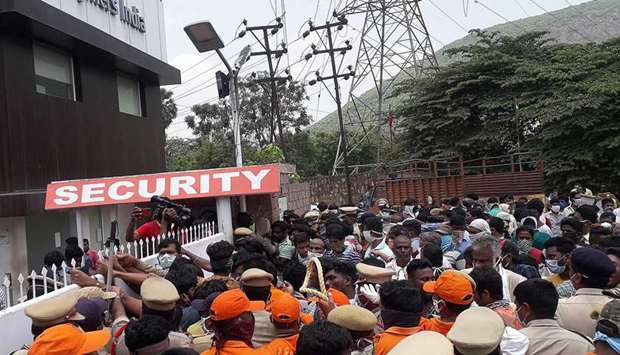
Villagers protest in front of LG Polymers company demanding justice to the gas leak victims, in Visakhapatnam yesterday.