


Britain united in tribute to the World War II generation as the Prince of Wales led a two-minute silence on a unique day of reflection and celebration to mark the 75th anniversary of victory in Europe.
Along bunting-lined streets, from front doorsteps, back gardens, and living rooms, people stood with heads bowed yesterday to mark the national moment of remembrance as wreaths were laid at war memorials during small, socially distanced ceremonies.
Prince Charles and the Duchess of Cornwall paid their respects at the Balmoral War Memorial in Scotland, as a lone piper played.
Charles, in highland dress, laid a wreath. The duchess, wearing the 4 Rifles dress and the regimental brooch of her father’s regiment, the 12th Royal Lancers, placed spring flowers she picked from their garden at their nearby Birkhall home.
Wreaths were also laid at Westminster on the anniversary of the day Sir Winston Churchill announced the war in Europe had come to an end after almost six years with the unconditional surrender of Nazi Germany.
Earlier, the Red Arrows streamed red, white and blue as they roared over central London, passing above The Mall, now deserted but which was to have been packed with thousands ahead of a veterans’ parade and the scene of joyful reunions with old comrades.
RAF Typhoon jets performed flypasts over Edinburgh, Cardiff and Belfast at the same time.
A Spitfire flypast soared over the white cliffs of Dover.
With original elaborate plans hastily rearranged because of Covid-19, the wartime generation, whom the Prime Minister, Boris Johnson, said had “carried the fate of freedom on their shoulders”, were confined to their homes.
Crowded street parties, one of the defining images of VE Day, are banned.
But even strict social distancing measures could not mute the mood of celebration as households across the country evoked the spirit of the 1940s, some dressing in period costume and hosting tea parties.
Where possible, care homes organised sing-a-longs and festivities for residents.
It may not have been the day planned, but VE Day 75 will itself become a footnote in history.
Dramatically scaled back events included a BBC special evening programme of celebration, featuring stars including the Welsh soprano Katherine Jenkins, and broadcast from the quadrangle at Buckingham Palace, which itself emerged bomb-scarred from the blitz.
It was from here George VI made his famous radio broadcast to the nation on May 8, 1945. The Queen’s special address was broadcast at 9pm, at the exact same hour.
It was followed by a nationwide rendition of wartime classic We’ll Meet Again, with Dame Vera Lynn, 103, joining from her home in East Sussex, and the public invited to sing from their doorsteps.
Churchill’s historic victory address was broadcast on the BBC at 3pm, exactly 75 years to the hour.
Prince Charles chose to read an extract from his grandfather’s diary of the day, outlining the royal family’s appearance on the balcony of Buckingham Palace, and lunch with Churchill.
The prime minister has written to veterans, who were to have been the focus of national and local parades and church services, but were forced to spend the day alone or with close family only.
He assured them that despite the ongoing lockdown, they and their efforts to defeat a “ruthless enemy” would not be forgotten.
“We cannot pay our tribute with the parades and street celebrations we enjoyed in the past; your loved ones may be unable to visit in person. But please allow us, your proud compatriots, to be the first to offer our gratitude, our heartfelt thanks and our solemn pledge: you will always be remembered,” he wrote.
Among those veterans was Capt Tom Moore, 100, who captured the nation’s heart by raising more than £32mn for the NHS through walking lengths of his garden.
Moore, the subject of an ITV documentary at 8pm yesterday, fought in Burma.
“It’s a very special day that is celebrating the end of a very fearsome war in Europe,” he told ITV’s Good Morning.
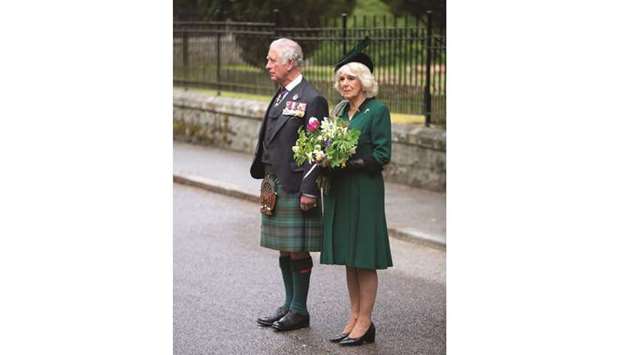
Prince Charles and his wife Camilla observe a two-minute silence to mark the 75th anniversary of VE Day at the Balmoral War Memorial, Scotland, yesterday.