


Indian stocks fell the most in more than a month yesterday, tracking losses in global peers after US President Donald Trump criticised China’s handling of the coronavirus pandemic and as the South Asian nation extended its nationwide lockdown. The rupee weakened.
The S&P BSE Sensex tumbled 5.9% to 31,715.35 points to mark its steepest drop since March 23, while the NSE Nifty 50 Index slid by a similar magnitude. Both gauges logged their biggest monthly gains since 2009 in April, and have rebounded by nearly 30% from lows touched a month earlier. Stocks dropped globally after Trump on Sunday said that Beijing misled the world about Covid-19.
India’s sovereign bonds fell.Sentiment was also dented after Prime Minister Narendra Modi on Saturday extended the stay-at-home orders for two weeks from May 4 even as he eased some restrictions and brainstormed ways to restart activity in Asia’s third-largest economy. India has reported 42,505 Covid-19 infections, and 1,910 deaths, according to data compiled by Johns Hopkins University.
Earnings and the economy will “take time to revive” even if all restrictions are lifted, said Ajit Mishra, research analyst at Religare Broking Ltd in Mumbai. The government may not ease the curbs “anytime soon considering the number of new cases we’re seeing everyday,” he said.
Reliance Industries Ltd, India’s biggest company by market value, on Friday posted a 40% drop in fourth-quarter profit while Hindustan Unilever Ltd. marked a 7% decline in sales volume amid global lockdowns to combat the virus. Nine of the Nifty 50 companies have posted earnings so far for the January to March period.
Seventeen of 19 sub-indexes compiled by BSE Ltd dropped, let by a gauge of financial stocks.
Lenders including IndusInd Bank Ltd and ICICI Bank Ltd were among the top losers on the benchmark index.
Bharti Airtel Ltd and Sun Pharmaceutical Industries Ltd were the only gainers on the Sensex index.
Meanwhile the rupee fell sharply yesterday amid broad weakness in other currencies and a big selloff in domestic equities. After opening at 75.71 per US dollar, the rupee fell to 75.81 at day’s low, before closing at 75.71. In comparison, the rupee had closed at 75.10 per dollar in the previous session. Forex market was closed on Friday on account of Maharashtra Day. The dollar index, which gauges the greenback’s strength against a basket of six currencies, rose by 0.38% to 99.47.
Asian currencies broadly slipped against the US dollar on growing tensions between the US and China over the origin of the coronavirus. US Secretary of State Mike Pompeo said on Sunday that there was “a significant amount of evidence” that the new coronavirus emerged from a Chinese laboratory. His comments come days after US President Donald Trump threatened to impose new tariffs on Beijing in retaliation over the coronavirus outbreak.
Factory output across several Asian countries, including India, slumped to record lows in April amid coronavirus-related restrictions. India’s factory activity, as measured by Nikkei Manufacturing Purchasing Managers’ Index, compiled by IHS Markit, plunged to 27.4 last month from March’s 51.8, by far its lowest since the survey began in March 2005.
Traders said the weakness in rupee was largely due to heavy correction in domestic equities and strengthening of the US dollar.
“While the equity expiry on Thursday saw the Nifty push towards 10,000 on massive short covering, the news flow since the close of our market on Thursday has been extremely disappointing both on the domestic as well as global front. The US is ramping up its aggressive rhetoric on China and this may manifest itself in the form of diplomatic or trade tensions in the near future,” says Abhishek Goenka, Founder and CEO, IFA Global.
“Just a day after North Korean dictator appeared after a 21-day absence, North and South Korea exchanged fire across the border, though experts believe the firing from North Korea side was accidental. Developments on this story need to be tracked closely.”
In India, the lockdown meanwhile has been extended to May 17.
“Though certain restrictions have been relaxed in green and orange zones, the overall pick up in economic activity is likely to be subdued as supply chains for big industries may be spread across red zones. The red zones such as Mumbai and Delhi are the most urbanised and are the nerve centres of the economy,” added Mr Goenka of IFA Global.
May has seasonally been a weak month for the the rupee and Indian currency is likely to track the broader dollar and global risk sentiment and may under perform this week as the corona cases’ curve does not seem to be flattening, says experts.
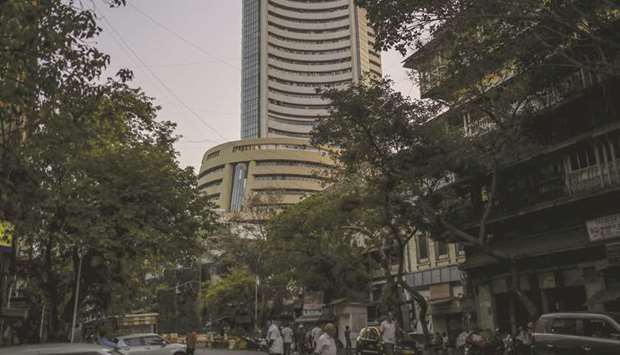
The Bombay Stock Exchange building in Mumbai. The Sensex tumbled 5.9% to 31,715.35 points to mark its steepest drop since March 23, while the NSE Nifty 50 Index slid by a similar magnitude yesterday.