


As communities transition from an enhanced quarantine to general quarantine, Senator Maria Lourdes Nancy Binay suggested the formation of an army of “Covid trackers” that would be deployed to curb the coronavirus pandemic.
On Saturday, Binay said the emergence of the coronavirus disease 2019 (Covid-19) had exposed the government’s weaknesses in managing public health, particularly in contact tracing.
She worries about the number of frontliners contracting the virus, adding that once the enhanced community quarantine was downgraded to general community quarantine, local governments should be ready and well-equipped to perform contact tracing.
She said contact tracing was an essential public health tool to help contain the spread of the coronavirus.
“If we can train enough volunteers from both health and non-health sectors, they will become the ‘army’ of public health fieldworkers and barangay (village) health workers trained to track down every case should the situation get worse,” Binay explained.
That army would be needed to prevent spikes and even a resurgence of a second wave of Covid-19 infections, she added.
“Contact tracing is a labour-intensive mission,” she said, adding, “We need to train practically a battalion of trackers deployed in small functional teams or units.”
She also said contact tracers could also be issued tablets or be told to use their personal smartphones from which they could download Covid-tracking apps.
Earlier, the Philippine National Police (PNP) announced it was looking into using a tracing app developed in the United States. Also, Apple and Google reported they, too, were working on a similar app that should be available this month. Countries like Australia and Singapore have also been using contact-tracing apps.
With public health guidance, Binay stressed the Department of Health, the Department of the Interior and Local Government (DILG) and local governments should still take the lead in creating a special unit of trackers who could make phone calls, visit communities, interview those in contact with suspected and confirmed carriers, as well as infected people who can be asymptomatic carriers who have exposed others without knowing it.
“We should never let our guards down and must strengthen our public health system’s key actions like testing capacity, isolation facilities, medical treatment and contact-tracing readiness,” she said.
Currently, the Inter-Agency Task Force for the Management of Emerging Infectious Diseases has tasked the DILG and the PNP to do contract tracing, given that law enforcers were trained in surveillance and information gathering. But without actual public health background and because of their unfamiliarity with the people and urban terrain, the DILG admitted having a hard time tracking down suspected Covid-19 carriers.
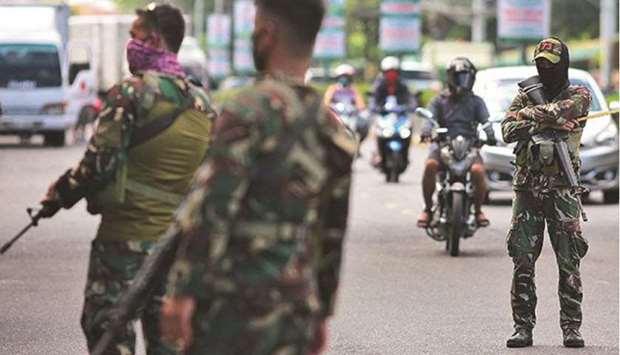
Philippine National Police (PNP) and soldiers from the Philippine Air Force (PAF) are on joint patrol to enforce strict physical distancing and community quarantine protocols at Kadiwa Market in Dasmarinas City, Cavite Province.