


Berlin authorities failed to enforce coronavirus restrictions and prevent large-scale May Day protests on Friday, officials admitted yesterday.
“The sheer mass of people meant that we could not ensure protection against infection in the way that I would have liked,” said Andreas Geisel, the official who was responsible for interior affairs.
Berlin police chief Barbara Slowik admitted to public broadcaster RBB that as many as “several thousand people” took to the streets of the capital to participate in traditional Labour Day protests despite the fact that they had been banned.
The largest gathering took place in Berlin’s Kreuzberg district, where the police’s attempts to break up groups of people were met with refusal and angry shouting.
The demonstration was not authorised, meaning that participants were breaking the law.
Slowik said any real attempt to disperse the crowd would have involved violence.
Hundreds of people marched through the central district of Kreuzberg, normally the epicentre of May Day unrest in Berlin, later on Friday, setting off fireworks and hurling insults at police officers.
The GdP police union said that just shy of 20 police officers were injured during the fracas, most of them by projectiles thrown by protesters and some in scuffles with participants.
Several suspects linked to an attack on a television camera team were among 25 people to appear before a judge yesterday.
The incident is being investigated by a special police division dedicated to politically-motivated crimes, Slowik told RBB.
The GdP said that the attack took place at a 100-strong protest in the central Mitte district against the restrictions imposed to halt the spread of the coronavirus.
It added that right-wing populists and conspiracy theorists had taken part.
The camera team that was attacked had been filming for the ZDF broadcaster’s Heute Show (Today Show), a satirical news programme.
A police spokeswoman said four victims had to receive hospital treatment for their injuries.
Six people have been arrested in connection with the attack.
Slowik noted that 209 people were detained, briefly or otherwise, by police officers over the course of May Day on Friday, traditionally a day of major protests and pockets of rioting in the German capital.
This year, major protests were cancelled due to the coronavirus pandemic.
A handful of smaller demonstrations were authorised under strict hygiene and social-distancing restrictions.
Although May Day demonstrations were largely peaceful, “hygiene regulations and demonstration requirements were flouted, thousands of people gathered in the tightest of spaces and thus massively increased the risk of infection”, GdP chief Joerg Radek said.
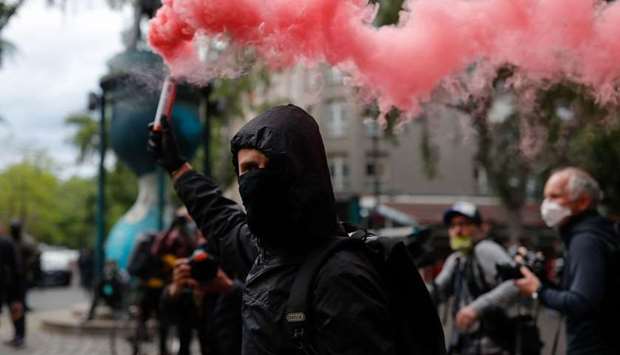
This picture taken on Friday shows a masked protester with a smoke bomb in the Kohlfurter Street, in Berlin’s Kreuzberg district, during May Day protests.