


Guardian News & Media/London
Protesters targeted more than 35 branches of Barclays’ bank yesterday with pickets, poetry readings and even children’s colouring competitions, in another of a series of days of direct action organised by the UK Uncut group.

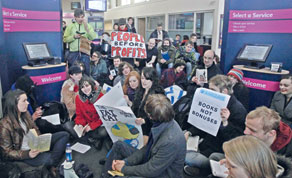
Demonstrators occupy a branch of Natwest bank and read books during a series of protests in central London yesterday. The demonstrators, who occupied the floor to set up a mock library symbolising one casualty of government funding cuts, are from a group called UK Uncut which highlights the issue of corporate tax avoidance
They were highlighting Barclays’ admission that it paid just £113mn in UK corporation tax in 2009 -- a year when it rang up a record £11.6bn of profits.
Several branches were closed down to the public as protestors staged peaceful sit-ins, impromptu reading groups and creches in dozens of cities and towns across Britain including Edinburgh, Birmingham, Liverpool and Lewes.
At Tottenham Court Road, one of eight branches of Barclays in London to be targeted, some 40 to 50 people heard comedienne Josie Lawrence pledge her support before a mixed group of people, both old and young, pushed their way into the branch and proceeded to hold a two hour sit-in.
Supporters of UK Uncut said the plan was not to shut the banks down, but to “open them up,” occupy them and transform them into “something people need, but will be cut.”
Ruth Griffiths, 36, a UK Uncut supporter, said: “Today we are transforming the banks into schools, leisure centres and libraries and forests because it’s society that’s too big to fail, not a broken banking system.”
The group staged “debate” points outside several of the branches and invited passers-by to discuss the cuts and the banks. Most of the gathered volunteers said people were angry at the refusal of Barclays’ chief executive Bob Diamond to apologise for the banks’ role in the economic crisis and saying the time for remorse was now over.
And yesterday Barclays was accused of living in a “parallel universe” following disclosure that it paid just £113mn of corporation tax on its £11.6bn of annual profits -- a rate amounting to just 1%.
The bank revealed the figure in response to questions posed at a parliamentary select committee by Labour MP Chuka Umunna, who described its low level as “quite staggering.”
It was a view shared by UK uncut supporters yesterday. One said: “We are here today because we are tired of companies ripping off the public and using economies of scale and clever accounting laws to get away with not paying taxes.
“We are tired of us paying into the public sector and seeing our public sector decimated while corporations are effectively getting away with theft. It’s legal but immoral.”
Emma Draper, 25, who was outside Piccadilly Circus Barclays, said: “The government is allowing banks such as Barclays to get away with not paying huge percentages of their taxes while at the same time slashing public services.
“The cuts are not necessary, they are a political choice because the government chooses to continue to prop up banks such as Barclays instead of funding public services.”
Explaining the figures, Barclays said it had operations in more than 50 countries and that it had used legitimate tactics to “carry over” losses made at the height of the financial crisis and to offset these deficits against its 2010 tax burden. Its total bill to the UK taxman was £2mn -- but most of this comprised payroll tax on employees’ wages.
“The corporate tax affairs of an organisation with the global footprint of Barclays are complex, and not reducible to simplistic comparisons,” said a Barclays spokesman.
But Umunna, who sits on the Treasury select committee, said the figure was totally inadequate: “We need to ensure the banks make a fairer contribution to reducing the deficit that they helped to create.”
Campaigners have contrasted Barclays, which paid out £2.5bn in salaries and bonuses last year, to the austerity squeezing the broader population. Max Lawson, a spokesman for the Robin Hood Tax Campaign, said: “This is proof that banks live in a parallel universe to the rest of us -- paying billions in bonuses and unhampered by the inconvenience of paying tax.”