


New York Governor Andrew Cuomo said yesterday that a screening of 3,000 people found nearly 14% tested positive for antibodies for the novel coronavirus, suggesting that 2.7mn residents across the state may have been infected with the disease.
He noted that the survey was preliminary and had limitations, including the possibility that New York, like California, would find the coronavirus was circulating and killing people earlier than previously known.
He said that the testing targeted people who were out shopping, meaning that they may be more likely to have been infected than people isolating at home.
Still, Cuomo said the preliminary data added to the state’s understanding of the virus and at least initially indicated a fatality rate of about 0.5% of confirmed cases that is far lower than some experts feared.
Over the past week, Cuomo has increasingly turned his attention to ramping up testing as hospitalisations, intubations and other metrics continue to improve, suggesting the state hit hardest by the pandemic has likely passed the worst stage.
Cuomo told a daily briefing that hospitalisations fell by more than 500 patients on Wednesday, the 10th straight day of decline.
He reported an additional 438 coronavirus-related deaths, down from 474 a day earlier and the lowest total since April 1.
Cuomo, a Democrat, called for a bipartisan approach to the virus, which has infected more than 845,000 Americans and taken nearly 48,000 lives, according to a Reuters tally.
But he took aim at US Senate Majority Leader Mitch McConnell, a Republican, for his comments on Wednesday suggesting that US states could file for bankruptcy to deal with massive economic losses stemming from the outbreak.
Cuomo, who has estimated his state is facing a $10-$15bn budget shortfall, called McConnell’s suggestion “one of the really dumb ideas of all time”.
“You wanna see that (stock) market fall through the cellar? Let New York State declare bankruptcy, let Michigan declare bankruptcy, let Illinois declare bankruptcy, let California declare bankruptcy? You will see a collapse of this national economy,” Cuomo warned. “So just don’t.”
Yesterday the US House of Representatives returned to Washington to pass a $484bn coronavirus relief bill, funding small businesses and hospitals and pushing the total spending response to the crisis to an unprecedented nearly $3tn.
The measure is expected to receive solid bipartisan support in the Democratic-led House, but threatened opposition by some members of both parties forced legislators to return to Washington despite stay-at-home orders intended to control the spread of the virus.
The Republican-led Senate passed the legislation on Tuesday by unanimous consent, allowing senators to stay at home.
Approval by the House will send it the White House, where Republican President Donald Trump has promised to quickly sign it into law.
The bill – which would be the fourth passed to address the crisis – provides funds to small businesses and hospitals struggling with the economic toll of a pandemic that has killed more than 47,000 Americans and thrown a record 26mn out of work over the past five weeks, wiping out all the jobs created during the longest employment boom in US history.
“This is really a very, very, very sad day. We come to the floor with nearly 50,000 dead, a huge number of people, and the uncertainty of it all,” Democratic House Speaker Nancy Pelosi said as debate began.
Congress passed the last coronavirus relief bill, worth more than $2tn, in March, with overwhelming support from members of both parties.
But the two parties have set the stage for an angry fight over additional funding for state and local governments reeling from the impact of lost revenue after Republicans refused to include it in the current relief bill.
Trump has said he supports more funding for states, and has promised to back it in future legislation.
But Republicans have resisted.
The vote will take place under safety protocols that will considerably lengthen proceedings.
Lawmakers have been instructed to wait in their offices for the vote, then come to the House in alphabetical order in small groups.
There will also be a half-hour break to clean the chamber between the first and second votes.
Most members in the chamber wore face masks, which many removed to speak.
The House will first vote on a new panel, with subpoena power, to probe the US coronavirus response.
Pelosi said the panel is essential to ensure funds go to those who need them and to prevent scams.
Republicans said it is not needed.
After that vote, which is likely to go along party lines, the House is expected to pass the $484bn coronavirus bill.
Echoing Trump, many Republicans also want the country – including Congress – to reopen more quickly than in the several more weeks recommended in many states.
“Congress is essential. The American public needs to see that we are working. The American public has to understand that we can do it in a safe manner so states and others can begin to open as well,” House Republican leader Kevin McCarthy said on Wednesday.
House members from both parties said they risked travelling to ensure that the legislation passed, some posting selfies on social media from airplanes on which passengers seemed outnumbered by crew.
“People who feel they can vote should be encouraged to vote. Those that don’t are not being pushed,” said Democratic Representative Pete Aguilar, one of a few party “whips” responsible for making sure floor votes occur without a hitch.
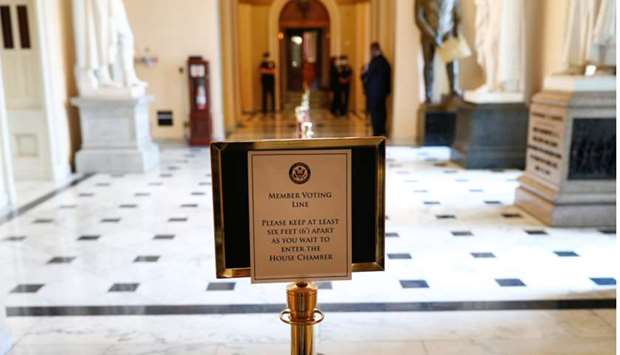
A sign indicating proper social distancing measures is displayed ahead of a vote later in the day in the House of Representatives on an additional coronavirus economic stimulus package passed earlier in the week by the US Senate.