


Johannesburg demolished around 80 shacks yesterday, sparking outrage as South African authorities reported a spike in illegal urban land grabs since the start of a five-week coronavirus lockdown.
Dressed in their infamous red overalls, the Red Ants security and relocation services tore down the makeshift dwellings made from corrugated iron.
“I was in the zozo (shack), I was sitting peacefully, until they came and they bulldozed the place down,” said Macy Gray, a resident in Lawley, a township on the southern outskirts of Johannesburg.
“We don’t know where to go, our children don’t have any place to stay,” said another resident, China Mashiya.
Human Settlements Minister Lindiwe Sisulu condemned the demolitions and evictions, which she said were in violation of the lockdown regulations.
“It is illegal now to remove any shack. If they wanted to remove them, it is unfortunate right now it is not possible,” Sisulu told a virtual parliamentary committee meeting.
Similar evictions were seen in Cape Town where law enforcement officials demolished a number of illegally built shacks in the city’s largest township of Khayelitsha.
The evictions come as the Gauteng province, the seat of the capital Pretoria and the financial hub of Johannesburg, recorded a spike in land grabs.
Alexandra township has seen at least seven incidents of illegal land occupations since the lockdown aimed at slowing the spread of the virus began on March 27.
“There has been a notable and concerning increase in illegal land invasions since the announcement of the lockdown,” said housing and urban planning provincial minister Lebogang Maile.
He said the “well-coordinated” invasions were “incited by connected criminal networks” preying on people desperate for housing.
At the start of the lockdown last month, the government announced a grand plan to relocate people from the overcrowded informal settlements to minimise the spread of Covid-19.
But the plan is yet to be implemented.
EASING OF CURBS
Burkina Faso and Ghana have eased some coronavirus lockdown restrictions this week to test the possibility of a return to a semblance of normality after weeks of shutdowns that have hobbled both economies, Reuters reported.
The West African countries have rising numbers of Covid-19 cases and it is unclear yet how bad it will become: Africa’s infections have lagged those in Europe, Asia and the United States but testing levels are low and the virus could wreak havoc in some of the world’s weakest health systems if cases skyrocket. In Burkina’s capital, Ouagadougou, markets had been closed since March 25. On Monday the government reopened one as a test to see if it could safely do the same with the rest by the end of the month. Sellers and customers who entered the market this week had to wear a mask, wash their hands and have their temperature taken, said Armand Beouinde, Ouagadougou’s mayor.
He said that only two people are allowed inside shops at one time, and that all shops had to carry hand sanitiser.
In Ghana, President Nana Akufo-Addo lifted a three-week lockdown in its two main cities, where non-essential businesses reopened. Akufo-Addo said the decision was made based on improved tracing of the disease, and to “protect the economy”.
One of Africa’s fastest growing economies, Ghana last month cut its 2020 GDP growth forecast from 6.8% to 1.5% due to the coronavirus pandemic, a rate that would represent its worst performance in nearly four decades. “There is no money to feed the family and myself when we stay at home,” said Atsu Nyavorwoyi, who works as a mechanic in the country’s capital Accra.
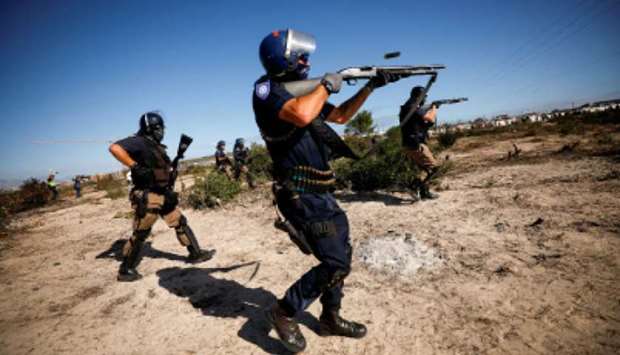
Police fire shotguns and tear gas as they attempt to disperse Khayelitsha township residents trying to erect shacks on open ground during a nationwide lockdown aimed at limiting the spread of the coronavirus disease (Covid-19), in Cape Town, South Africa yesterday.