


China’s economy contracted for the first time on record in the first quarter as the coronavirus shut down factories and shopping malls and put millions out of work.
Gross domestic product (GDP) fell 6.8% in January-March year-on-year, official data showed yesterday, a slightly larger decline than the 6.5% forecast by analysts and reversing a 6% expansion in the fourth quarter of 2019.
It was the first contraction in the world’s second-largest economy since at least 1992, when official quarterly GDP records were first published.
Providing a silver lining was a much smaller-than-expected fall in factory production in March, suggesting tax and credit relief for virus-hit firms was helping restart parts of the economy shut down since February.
However, analysts say Beijing faces an uphill battle to revive growth and stop massive job losses as the global spread of the virus devastates demand from major trading partners and as local consumption slumps.
“First-quarter GDP data is still largely within expectations, reflecting the toll from the economic standstill when the whole society was on lockdown,” said Lu Zhengwei, Shanghai-based chief economist at Industrial Bank.
“Over the next phase, the lack of overall demand is of concern. Domestic demand has not fully recovered as consumption related to social gatherings is still banned while external demand is likely to be hammered as pandemic spreads.”
On a quarter-on-quarter basis, GDP fell 9.8% in the first three months of the year, the National Bureau of Statistics said, just off expectations for a 9.9% contraction, and compared with 1.5% growth in the previous quarter.
Statistics bureau spokesman Mao Shengyong told a press briefing after the data that China’s economic performance in the second-quarter is expected to be much better than in the first.
However, weaker domestic consumption, which has been the biggest growth driver, remains a concern, as incomes slow and the rest of the world falls into recession.
Per capita disposable income, after adjusting for inflation, fell 3.9% from a year earlier in the first quarter, the data showed.
“We are hesitant to think that this is just a one quarter event, Q2 will also likely be lower than expectation,” said Ben Luk, senior multi asset strategist at State Street Global Markets in Hong Kong. “To offset weakness in external demand, we will see some policy support later this month or early May.”
Industrial output fell by a less-than-expected 1.1% in March from a year earlier.
Highlighting the challenges in consumption, however, was a 15.8% fall in retail sales, which was larger than expected.
Fixed asset investment dropped 16.1% in January-March from a year earlier.
Investors and policymakers worldwide are closely watching to see how long it takes China to recover from the virus shock, as the United States and a number of other afflicted countries begin to consider cautious reopenings of their economies.
“As long as there are strict social distancing measures, the recovery of activity will be very slow, and this will be reflected in consumption,” analysts at ING said in a note.
Economists’ forecasts for first-quarter GDP had ranged widely given the many uncertainties around the pandemic’s economic and social impact in China.
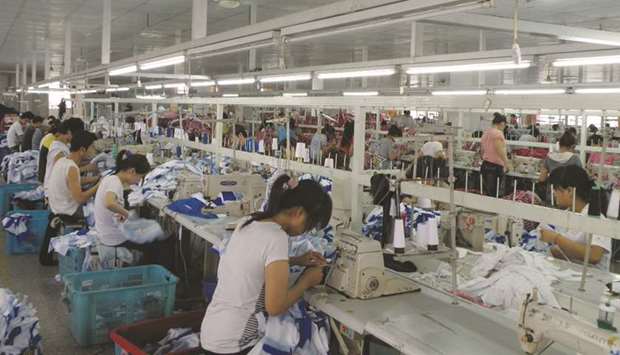
Workers make Orolay jackets at the company’s factory complex in Jiaxing, Zhejiang province. China’s gross domestic product fell 6.8% in January-March year-on-year, official data showed yesterday, a slightly larger decline than the 6.5% forecast by analysts and reversing a 6% expansion in the fourth quarter of 2019.